Learn Portuguese Grammar
Portuguese grammar is more than a set of rules, it’s the framework that brings this warm, expressive language to life. From verb endings to sentence rhythm, every part of the system helps you sound natural and confident. And with Promova, learning those rules becomes simple, practical, and even fun.
..Our Portuguese basic grammar lessons are designed for real-life use. You’ll learn how to talk about your day, describe things, and express feelings, all while building a solid understanding of how European Portuguese works.

What is Portuguese grammar all about?
Portuguese is a Romance language, just like Spanish and French, which means it uses patterns of agreement and conjugation. Every noun has a gender (masculine or feminine), and adjectives must match it. Verbs take different endings depending on who is speaking (eu falo, tu falas, ele fala) and what time you’re referring to (falava, falarei).
In European Portuguese, subject pronouns like “tu” are more common than “você,” and object pronouns often appear after the verb and are joined with a hyphen — for example, ajuda-me, viu-o, encontrar-te-ei.
Word order is usually Subject–Verb–Object, but can shift for emphasis: Hoje estudo português (Today I study Portuguese). Once you see the structure, you’ll realize that grammar isn’t the hard part, but the tool that makes everything connect.
Portuguese grammar skills help you to:
Understand how to form correct sentences without memorizing endless charts.
Use verbs naturally in conversations and storytelling.
Recognize patterns, so grammar feels natural, not forced.
Speak and write Portuguese confidently from day one.
Enjoy lessons that connect grammar to real communication, not just theory.
Portuguese Grammar Reference Guide
Learn basic Portuguese grammar rules with this quick guide:
1. Parts of Speech in Portuguese
Learn the structure of Portuguese grammar with this clear and concise guide. Every word in Portuguese belongs to a grammatical category, and each category follows its own rules for how it behaves in a sentence.
Nouns name people (Maria), objects (livro – book), places (Lisboa – Lisbon), or ideas (liberdade – freedom). Every noun has a gender (masculine or feminine) and a number (singular or plural). Nouns also determine agreement for articles and adjectives.
Verbs express action, state, or occurrence and are highly inflected, changing form according to person, tense, and mood. Verbs can appear in moods such as indicative (facts), subjunctive (doubt or emotion), imperative (commands), and infinitive (general actions). European Portuguese frequently uses the personal infinitive and future subjunctive.
Adjectives describe nouns and must agree with them in gender and number. Adjectives usually come after the noun but can appear before it for emphasis or stylistic effect: “bela cidade” (beautiful city).
Adverbs modify verbs, adjectives, or other adverbs, indicating how, when, where, or to what degree something happens. Adverbs do not change form, and many are formed by adding -mente to the feminine adjective (rápida → rapidamente).
Pronouns replace nouns to avoid repetition and agree in gender and number. They can be: Personal, reflexive, relative and possessive, and demonstrative. In European Portuguese, pronouns often appear after the verb and are linked with a hyphen: ajuda-me! (help me!)
Prepositions show relationships between words, expressing direction, time, cause, or possession. Some prepositions combine with articles to form contractions: de + o = do, em + a = na. Example: Estou em casa. (I’m at home.)
Conjunctions connect words or clauses. They include coordinating conjunctions in Portuguese like e (and), mas (but), and ou (or) and subordinating conjunctions, such as porque (because), quando (when), and se (if).
Interjections express emotions or spontaneous reactions. They often stand alone and are very common in spoken Portuguese.
Articles introduce nouns and show whether they are specific or general. The definite articles o, a, os, and as mean “the,” while the indefinite articles um, uma, uns, and umas mean “a,” “an,” or “some.” Articles must always agree in gender and number with the nouns they accompany.
Determiners function like articles but add precision or quantity. They include demonstratives, possessives (meu, seu), quantifiers (muito, pouco), and indefinites (algum, nenhum). Determiners come before the noun and, like articles, affect adjective agreement.
Numerals indicate quantity (dois livros – two books), order (primeiro lugar – first place), or repetition (duas vezes – twice). They can act as adjectives, nouns, or adverbs, depending on context.
Particles are small words that add emphasis, emotion, or subtle meaning, often used in spoken language. Common European Portuguese examples include “lá,” “cá,” “bem,” and “é que.” These emphasize or clarify a sentence's tone and focus.
2. Sentences in Portuguese
In Portuguese, sentences (as frases) are groups of words that express complete ideas. Every sentence must include at least a subject (explicit or implied) and a verb. Portuguese follows relatively flexible word order compared to English, but certain patterns and structures determine clarity and emphasis.
In Portuguese, the standard word order is Subject–Verb–Object (SVO). However, this order can change for emphasis or rhythm, especially in spoken or literary contexts. Even when the word order shifts, verb conjugation and context usually make the meaning clear. In European Portuguese, this flexibility is often used for stylistic emphasis.
A clause is a group of words built around a conjugated verb. Main clauses can stand alone, while subordinate clauses depend on a main clause. Every complete Portuguese sentence must include at least one main clause, though it may also contain subordinate clauses to add detail or complexity.
Portuguese sentences serve different purposes. Declarative sentences make statements, interrogative sentences ask questions, imperative sentences give commands, and exclamative sentences express emotions. European Portuguese often uses different question intonation patterns than Brazilian Portuguese; rising intonation is softer and more subtle. Each type conveys a different intention or tone.
Sentence structure in Portuguese depends on how clauses relate to each other. Simple sentences have one clause, compound sentences include two or more main clauses connected by a conjunction, and complex sentences combine a main clause with one or more subordinate clauses.
Indirect speech reports what someone said without quoting them directly. For example, in direct speech, you might say, Ela disse: “Eu vou viajar” (She said, “I’m going to travel”), while in indirect speech, it becomes Ela disse que ia viajar (She said she was going to travel). In European Portuguese, reported speech tends to use the imperfect tense more consistently, especially in formal contexts.
In Portuguese, verbs must agree with their subjects in person and number. This rule is consistent and helps clarify who performs the action.
Conjunctions and linking adverbs connect ideas smoothly. Example: “Estudei muito, por isso passei no exame”. (I studied a lot, therefore I passed the exam.) Other common European Portuguese connectors include “assim”, “logo”, and “portanto”, which are frequently used in formal writing.
Portuguese punctuation is similar to English: period (.), comma (,), semicolon (;), question mark (?), and exclamation mark (!). Commas are used more frequently, especially to separate clauses. Quotation marks in European Portuguese are usually «...», though “...” may appear in informal or digital contexts.
Extra or explanatory information can appear between commas, dashes, or parentheses.
Portuguese uses cleft structures to emphasize a specific element in a sentence, drawing focus or contrast.
Portuguese distinguishes between active voice (the subject performs the action) and passive voice (the subject receives the action). The passive voice appears more often in formal writing, while the active voice is preferred in everyday speech.
3. Tenses in Portuguese
In Portuguese, tenses show when an action happens and how it unfolds over time. Verbs change their endings to express tense, aspect, mood, and person, helping speakers describe actions clearly in the past, present, or future. Because Portuguese is a highly inflected language, verb conjugation plays a central role in communication.
Portuguese verbs have non-finite forms that are not tied to a specific subject: the Infinitive, the Gerund, which expresses ongoing action, and the Past Participle, used for compound tenses and passive voice. European Portuguese also uses the personal infinitive frequently, a unique form that shows agreement with the subject, e.g., para eu fazer (for me to do).
Used to describe actions happening right now, habitual actions, or general truths. It can also refer to near-future actions when the time is clear.
Describes actions that were ongoing, repeated, or habitual in the past. It also sets the scene in storytelling.
Indicates actions that were completed in the past. In European Portuguese, it’s more common than the compound past, which is used mainly for ongoing or repeated actions.
Describes an action that happened before another past action. It can appear in a simple or compound form. The simple form is still used in formal European Portuguese but is rare in Brazilian usage.
Expresses actions that will happen in the future or probabilities about the present. In spoken Portuguese, the simple future is often replaced by ir + infinitive: Vou estudar amanhã. (I’m going to study tomorrow.). However, European Portuguese still uses the simple future frequently in both formal and spoken contexts.
Describes an action that will have been completed before a future point in time. Formed with ter/haver + past participle.
Expresses possibility, politeness, or hypothetical situations in Portuguese.
Used to express doubt, emotion, desire, or uncertainty. In Portuguese, it appears in several tenses: present subjunctive, imperfect subjunctive, and future subjunctive. The future subjunctive is especially common in European Portuguese and plays a key role in expressing conditions or uncertainty.
It’s used for commands, instructions, or invitations in Portuguese. In European Portuguese, the informal imperative often matches the present indicative, while the negative imperative uses the subjunctive.
4. Portuguese Grammar Rules
It’s important to understand the basic Portuguese grammar rules, as they are the foundation of how the language works. Once you understand them, you can build sentences that are accurate, expressive, and natural.
Portuguese relies on agreement, verb conjugation, and word order, and while it may seem complex at first, its structure follows clear and logical patterns that make communication easy and precise once mastered.
Common challenges for Portuguese grammar learners include gender confusion, verb tense mix-ups, and preposition errors. Another frequent issue is agreement — forgetting to match adjectives and verbs with their subjects or nouns. Small mistakes like these can change the meaning, but regular practice quickly improves accuracy.
In Portuguese grammar, words must agree in gender (masculine/feminine) and number (singular/plural). This rule gives sentences balance and clarity and is essential for fluent, natural expression.
Portuguese has many similar-looking words that can cause confusion. Learning their meanings and contexts helps avoid common mix-ups.
Plural formation in Portuguese follows several patterns, depending on word endings. Articles and adjectives must always match in number.
Portuguese word order is generally Subject–Verb–Object (SVO). However, flexibility is allowed for emphasis or rhythm, especially in spoken or poetic language. Verb conjugation and context make meaning clear even when word order changes.
Portuguese sentences are flexible but structured. Verbs often “frame” the sentence around the main idea, with non-finite verb forms (like the infinitive or participle) appearing near the end. Adverbs and objects usually fill the middle of the sentence, maintaining a natural rhythm and flow.
Negation is simple and direct: Just place “não” before the verb. Other forms include “nunca” (never), “jamais” (never/ever), and “nada” (nothing). In European Portuguese, double negatives like “não vi nada” (I didn’t see anything) are grammatically correct and very common.
Portuguese questions can be formed in several ways: by using rising intonation in a statement, with question words such as Quem? (Who?), O que? (What?), and Quando? (When?), or through inversion of subject and verb, which is more formal or typical in writing. European Portuguese often uses inversion more frequently in formal contexts.
Portuguese uses short confirming tags like: não é? (isn’t it?), né?, or tá? (casual, spoken forms).
Portuguese verbs convey actions through mood and voice. The three main moods are the indicative, the subjunctive, and the imperative. Additionally, the passive voice shows that the subject receives the action.
The subjunctive mood in Portuguese is used to express hypothetical or uncertain situations and includes three tenses: the present, the imperfect, and the future.
In Portuguese, a simple subject has just one noun or pronoun, while a compound subject includes two or more nouns joined by e or ou. The verb must always agree with the full subject.
A direct object receives the action directly, while an indirect object shows to or for whom something is done. Pronouns can replace these objects, as in Comprei-o (I bought it) and Dei-lhe o livro (I gave him the book).
Portuguese has many irregular verbs that change their stems or endings across tenses. Since these verbs are used frequently, mastering their irregular forms is essential for fluency.
Portuguese punctuation helps create clarity and a natural flow in writing. Commas are used to separate phrases and clauses, while periods and semicolons mark sentence endings or pauses. Quotation marks vary by region, using either «...» (standard European form) or “...”. Unlike English, Portuguese uses commas for decimals (e.g., 7,5 euros), and punctuation marks like exclamation points and question marks are written without a space before them.
Start learning Portuguese today
Start your learning journey today with tailored study tips and interactive Portuguese exercises with cultural context to help you strengthen your skills and keep learning European Portuguese grammar with confidence with Promova.
Begin learning basic Portuguese grammar with Promova
— 01
Adaptive learning
Every learner is different, and Promova understands that. Our adaptive system adjusts each Portuguese grammar lesson based on your current level and learning pace.
— 02
Daily challenges
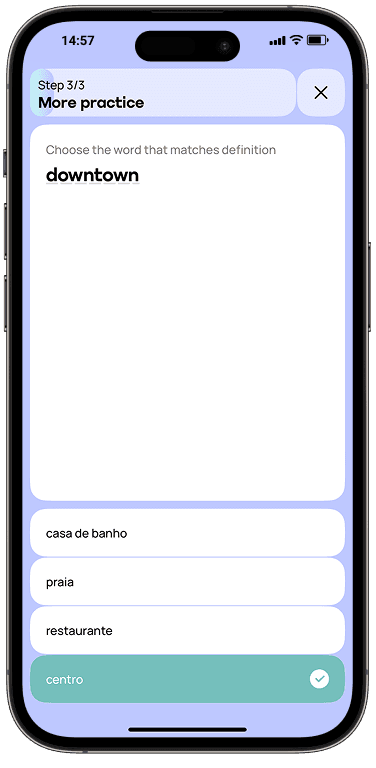
Turn Portuguese grammar practice into a fun daily habit. Promova’s bite-sized challenges help you review tenses, pronouns, and sentence rules without pressure.
— 03
Topic-specific vocabulary
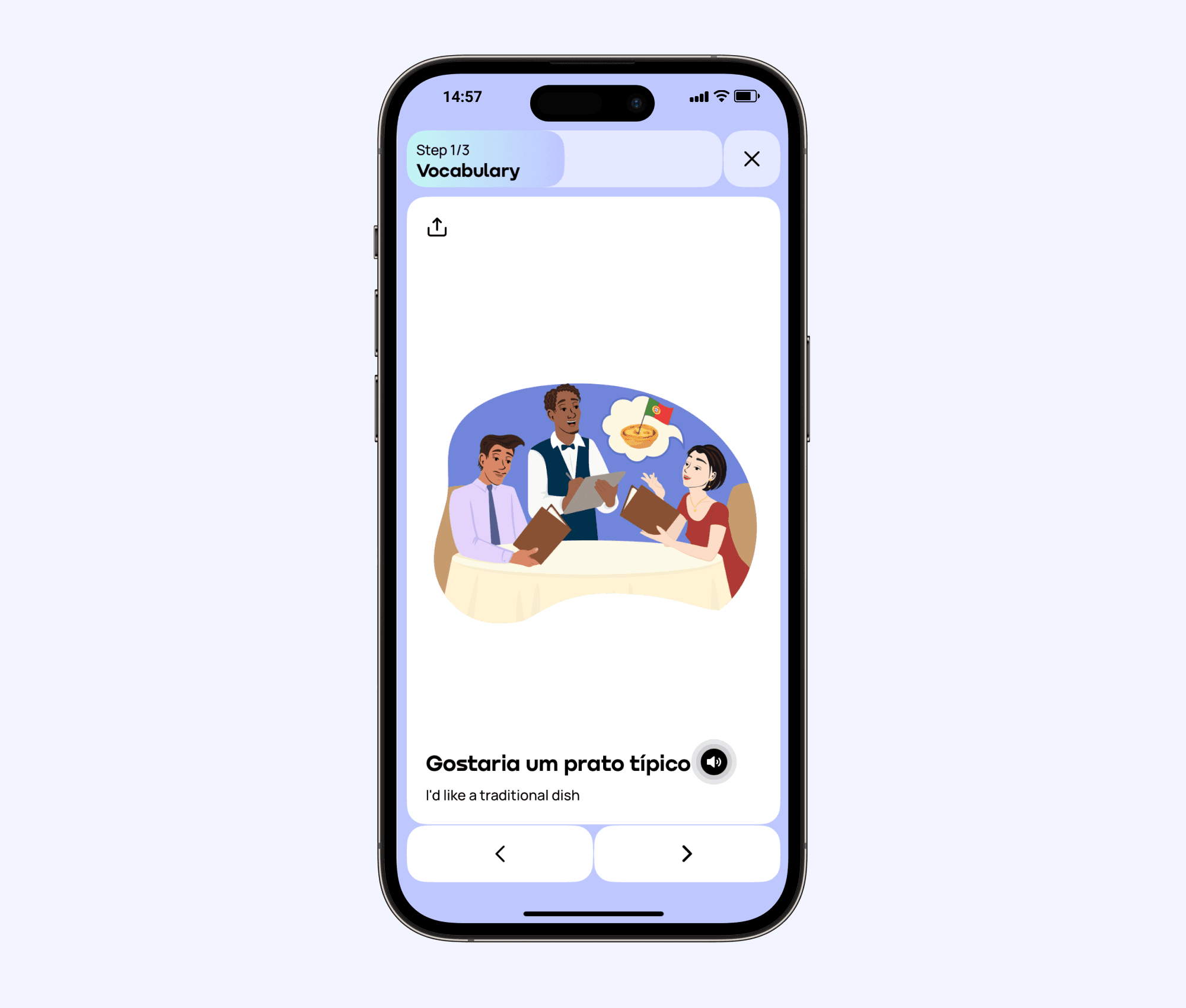
Portuguese grammar is easier to learn when it’s connected to real life, not just memorization. Each lesson includes vocabulary and examples from everyday topics — like food, travel, or work.Examples use European Portuguese words such as “autocarro”, “pequeno-almoço”, “telemóvel”, and “casa de banho”.

— 04
Supportive environment
At Promova, you’re never judged for making mistakes. Our platform offers a safe, supportive environment where you can experiment, repeat exercises, and learn at your own rhythm.
— 05
Progress tracking
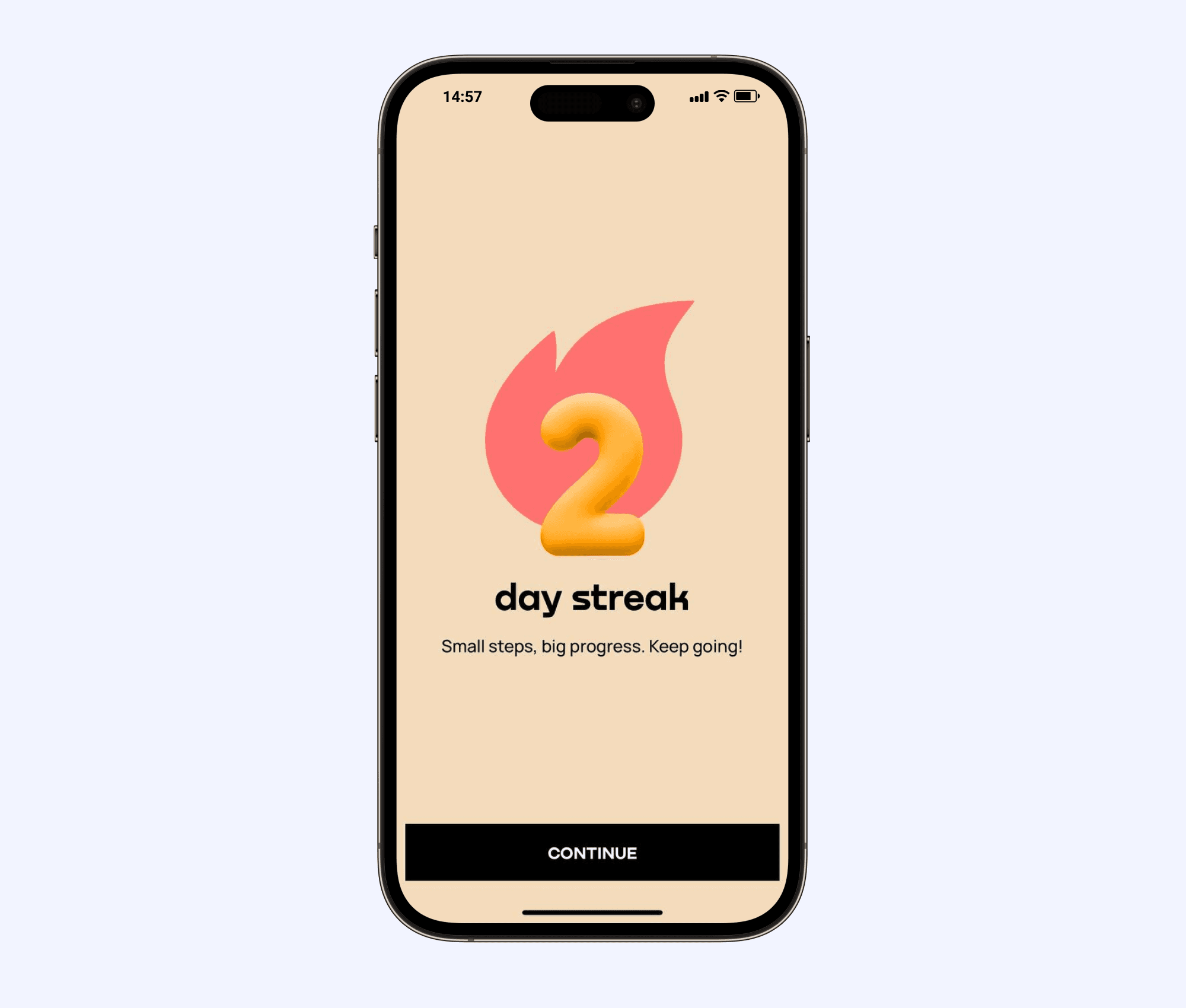
Promova tracks your accuracy, speed, and consistency, showing your strongest areas and where you can improve. You’ll see your skills evolve in real time, a clear reminder of how far you’ve come.
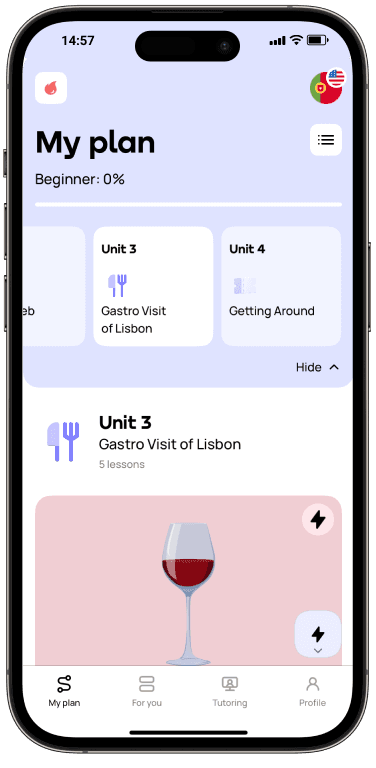
— 06
Personalized dashboard
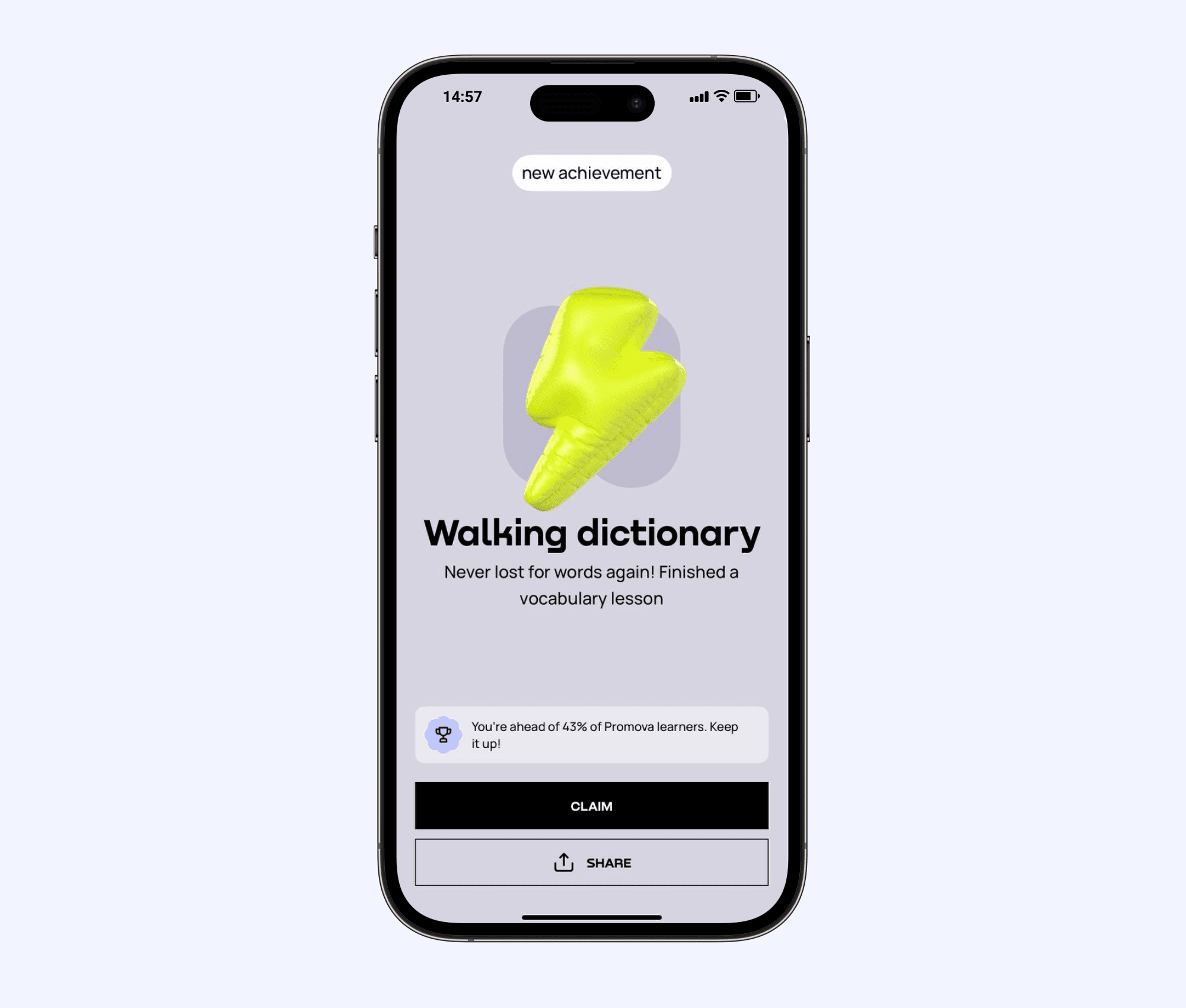
Your Promova dashboard keeps everything organized: lessons, goals, achievements, and grammar stats. You can review old topics, repeat tricky ones, and plan what to study next.
Free Portuguese grammar resources
People often ask
Can I learn Portuguese grammar even if I’m a complete beginner?
Absolutely! You’ll start with the simplest grammar topics — like sentence structure and pronouns — and gradually move to tenses, moods, and expressions. Everything is explained in a clear, friendly way, making basic Portuguese grammar approachable and fun from day one.
Does Promova teach Brazilian Portuguese grammar or European Portuguese grammar?
Promova focuses on European Portuguese grammar and usage, helping learners understand the language as it’s spoken in Portugal. You’ll also find clear notes explaining differences between European Portuguese grammar and Brazilian Portuguese grammar — so you can recognize both varieties with ease.
What are the best Portuguese grammar lessons online?
Promova offers fairly good Portuguese grammar lessons that combine structure with real-world examples. You’ll practice Portuguese grammar through vocabulary, dialogues, and short quizzes that show you how to use European Portuguese naturally in conversation.
Will it take long before I can use Portuguese grammar fluently?
It depends on your goals and how consistently you study. Most learners start using Portuguese grammar comfortably within 3 to 6 months of regular practice. Promova’s adaptive learning and daily challenges make the process engaging, helping you go from understanding the Portuguese grammar rules to using them automatically in speech.
Is Portuguese grammar harder than English grammar?
At first, Portuguese grammar may seem more complex because of its verb conjugations, gendered nouns, and accent marks, but once you understand the structure, it becomes very logical. Promova breaks each rule into simple explanations and examples so you can learn naturally and confidently.
 English
 Français
 Español
 Português


