Learn German Grammar
German grammar has a reputation for being tough—but it’s really just detailed. Once you understand the patterns, it becomes one of the most logical language systems to learn.
..With Promova, you’ll discover that German grammar doesn’t have to be boring or overwhelming. Our lessons break complex topics into small, simple steps so you can start forming correct sentences and speaking with confidence from day one.
What is German grammar all about?
Learning the German grammar basics gives you the tools to create meaning through cases, genders, and word order. Instead of relying on word position like in English, German grammar uses endings and structure to show who is doing what in a sentence. This means you can move words around—and still make perfect sense.
Every noun has a gender, every verb follows a clear conjugation pattern, and the famous “second-position verb rule” gives German its unique rhythm. Once you understand these foundations, the language opens up in a logical and consistent way.
German grammar skills help you to:
Learn to read and build sentences that make sense, no matter their order.
Use cases and verb forms correctly in speech and writing.
Understand how to rearrange words naturally while keeping meaning clear.
Spot common mistakes early and use proper endings automatically.
Express complex ideas easily with correct grammar and structure.
German Grammar Reference Guide
Learn German grammar structure with this quick guide:
1. Parts of Speech in German
German grammar divides words into several categories, each with its own patterns and functions. While there are eight traditional parts of speech, articles, determiners, numerals, and particles play such important roles that they’re often treated as separate categories.
German nouns are unique because they are always capitalized. Every noun has one of three genders (masculine, feminine, or neuter) and changes form depending on the case (nominative, accusative, dative, or genitive).
Verbs are the heart of German sentences. They express action, state, or process. German verbs conjugate according to person, tense, and mood, and their placement in the sentence can change depending on whether it’s a statement or a question.
Describes a noun, usually coming before it. Adjectives must decline (change their endings) to agree with the noun's case, gender, and number, unless they are used predicatively.
Modifies a verb, an adjective, or an entire sentence. They specify how, when, where, or why something happens. Crucially, adverbs never change form (they do not decline)
Pronouns replace nouns to avoid repetition. They adapt to gender, case, and number and common types include: Personal, reflexive, relative and possessive pronouns.
Prepositions show relationships between words and control which case follows them. Some always take the accusative, others the dative, and some can take both depending on movement.
Conjunctions connect ideas. There are coordinating conjunctions that link equal parts of a sentence, and subordinating conjunctions that introduce dependent clauses and send the verb to the end.
Interjections express emotions or reactions. They often stand alone and bring life to spoken German.
Articles introduce nouns and define their meaning. They also signal gender, number, and case. They are essential because they determine the form of adjectives and help identify each noun’s grammatical role.
Determiners behave like articles but aren’t classified as such. Determiners always appear before the noun and trigger adjective declension, influencing adjective endings just like articles do.
Numerals express quantity or order and can function in different ways: As adjectives, as nouns, or as adverbs. Because they don’t always behave like other word types, numerals are often treated as a separate category in German grammar.
Particles are small words that don’t change form or influence grammar but add tone, emotion, or focus to what’s being said. They include modal particles and focus particles, which are subtle yet powerful tools that bring nuance and personality to German speech.
2. Sentences in German
In German, sentences (die Sätze) are structured combinations of words that express complete ideas. German grammar places great importance on word order, which changes depending on whether the sentence is a statement, question, or subordinate clause. The position of the verb determines the sentence type and flow.
In German, main clauses follow a Subject-Verb-Object (SVO) order, but the verb always comes second. In subordinate clauses, the verb moves to the end.
A clause needs at least a subject and a conjugated verb. Main clauses can stand alone, while subordinate clauses depend on a main clause and end with the verb. Every sentence must have at least one main clause.
German sentences can express different purposes: declarative for statements, interrogative for questions, imperative for commands, and exclamatory for emotions.
German sentences can be simple (one clause), compound (multiple main clauses), or complex (a main clause plus subordinate clauses).
Indirect speech reports what someone said without quoting them directly, often using the subjunctive. In everyday speech, the indicative can be used if the meaning is clear.
Verbs must agree with their subjects in person and number. This agreement is one of the most consistent features of German grammar.
Connecting words make sentences flow naturally. Common conjunctions and adverbs include und (and), aber (but), deshalb (therefore), dann (then), trotzdem (nevertheless).
German punctuation uses periods, commas, semicolons, question marks, and exclamation marks. Commas appear more often than in English, especially between clauses. Quotation marks are usually „...“ or »...«.
Extra or explanatory information is added between commas, dashes, or parentheses.
Used to emphasize a part of the sentence.
The active voice highlights who performs the action, while the passive voice focuses on the action itself or the recipient. The passive is often used in formal or scientific writing.
3. Tenses in German
In German, tenses show when an action takes place and how it develops over time. Verbs change their forms according to tense, aspect, mood, and person, allowing speakers to express events in the past, present, or future with precision.
German verbs have non-finite forms: the infinitive (base form), Participle I (ongoing action), and Participle II (used in compound tenses).
The present tense describes actions happening now, repeated actions, or general truths. It is also often used for the near future when time is specified.
Used mainly in written German, storytelling, and literature to describe past events or sequences. In spoken German, this tense is often replaced by the present perfect.
The most common past tense in spoken German. It describes completed actions that still connect to the present. Formed with haben or sein + past participle (Partizip II). Verbs of movement or change of state usually take sein.
Used to describe actions that happened before another past event. Formed with hatte/war + past participle.
Expresses actions that will happen in the future or assumptions about the present. Formed with werden + infinitive.
Describes an action that will have been completed by a specific point in the future. Built with werden + past participle + haben/sein.
Used mainly in reported or indirect speech to show that information comes from another source. In everyday German, it often overlaps with indicative forms, especially when the context is clear.
Used to express unreal or hypothetical situations in the past. Formed with hätte or wäre + past participle.
Used for commands, instructions, or requests. Exists for du, ihr, and Sie forms.
4. German Grammar Rules
German grammar rules form the backbone of the language. Once you understand how they work, you can create clear, precise, and natural sentences. German is a rule-based system where word order, gender, and case determine meaning—but once you learn the patterns, everything fits together logically.
Common challenges for German learners include mixing up cases (der/dem/den), incorrect verb placement, and confusing genders (die Tisch instead of der Tisch). Many also forget to move verbs to the end of subordinate clauses (weil ich müde bin, not weil ich bin müde).
In German grammar, words must agree in form: verbs match their subjects, adjectives match the noun’s case, gender, and number, and articles change with the case.
Many German words look or sound alike but have different meanings, such as "das" vs. "dass" or "seid" vs. "seit". Knowing these helps avoid confusion and improves accuracy.
German plurals follow different patterns with endings like -e, -en, -er, or -s, sometimes with a Umlaut change. Adjectives and articles must also match the plural form: die alten Häuser (the old houses).
German word order is flexible but logical: in main clauses, the conjugated verb always appears in second position; in questions, it always comes first; and in subordinate clauses, the verb moves to the end.
A distinctive feature of German grammar is the sentence frame. In main clauses, the conjugated verb (V2) stands near the beginning, while the non-finite verb part (the infinitive, prefix, or participle) appears at the end. All other elements, such as objects and adverbs, fill the space in between.
Negation in German uses "nicht" to negate verbs or adjectives, and "kein" to negate nouns. Nicht usually comes before what it’s negating, while kein replaces the article with “no” or “none.”
German questions come in different forms: yes/no questions put the verb first, W-questions start with a question word, and indirect questions use words like "ob" or "wann."
Instead of English-style tags, German uses short confirming phrases, such as "oder?", "nicht wahr?", or "ne?".
German verbs show moods like Indikativ (facts), Konjunktiv (hypothetical), Imperativ (commands), and the passive voice, where the subject receives the action.
This mood is used for indirect speech, wishes, and unreal situations. Konjunktiv I is used for reporting, and Konjunktiv II for hypotheticals or polite expressions.
A simple subject consists of one noun or pronoun, while a compound subject connects multiple nouns with und or oder. The verb must always agree with the full subject.
The direct object (Akkusativ) gets the action directly, while the indirect object (Dativ) shows who receives it. Object pronouns like “ihn” replace nouns for smoother sentences.
German has many strong (irregular) verbs that change vowels and have unique past forms. Learning them is important for past and perfect tenses.
German punctuation keeps things clear with frequent commas between clauses, capitalized nouns, „...“ or »...« for quotes, commas for decimals (5,5 Euro), and no space before marks like ! or ?.
Put Your German Grammar Level to the Test
Wondering how well you really know German grammar? Take our quick 20-minute online test to find out! You’ll answer short, multiple-choice questions that cover everything from verb endings to word order. Get your score instantly, along with personalized tips to strengthen your German grammar skills and German grammar exercises to keep improving with confidence.
Start to learn German grammar online with Promova
— 01
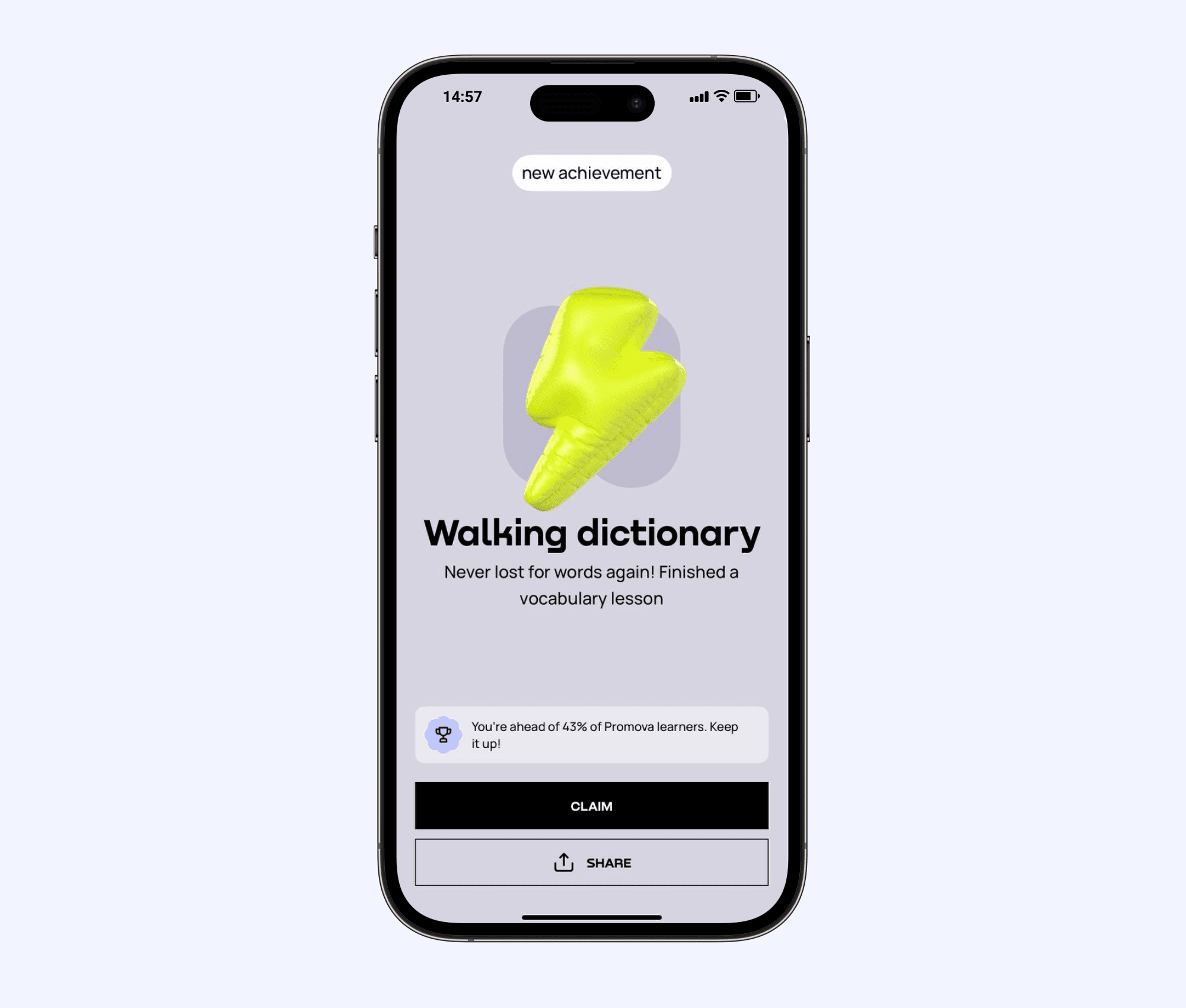
Adaptive learning
Promova adapts every German grammar lesson to your individual pace and progress. The app analyzes your performance and identifies areas for improvement, offering personalized exercises that make mastering complex topics (such as cases, articles, and word order) easier and faster.
— 02
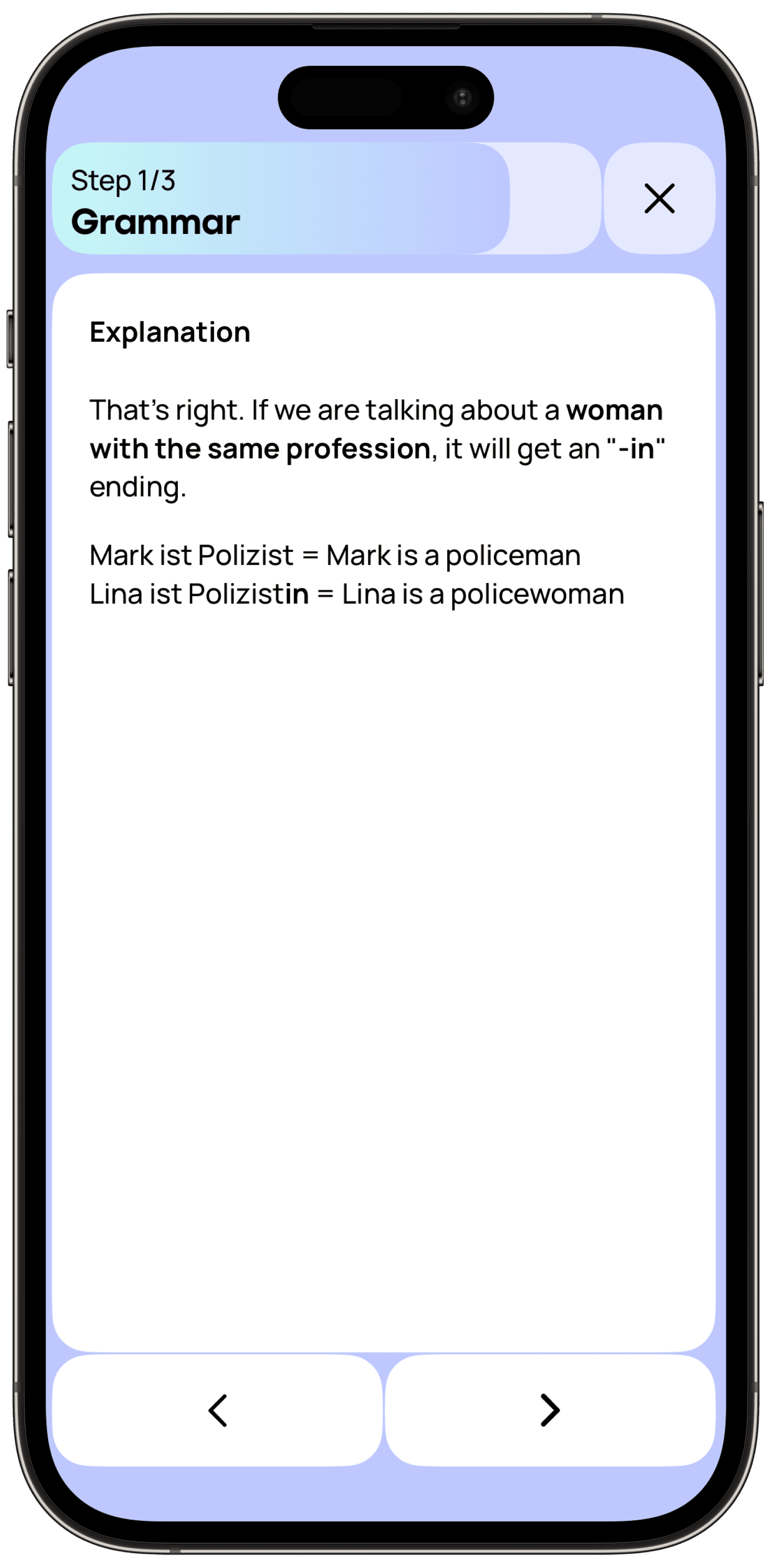
Daily challenges
Build consistency with quick, enjoyable grammar challenges each day. Review essential German grammar rules, test yourself with bite-sized quizzes, and earn badges as you improve. Just 10 minutes a day can make a big difference in your understanding.
— 03
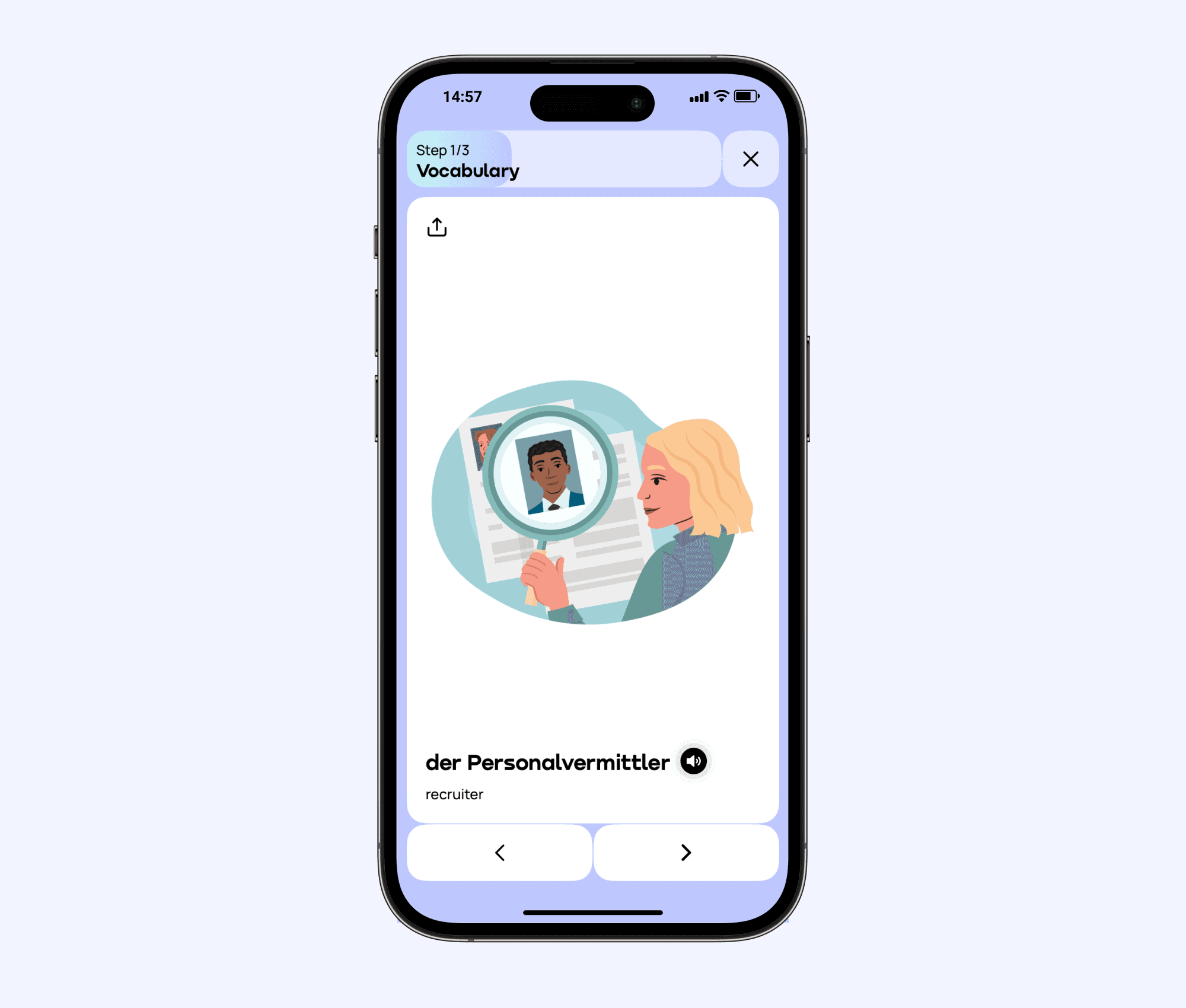
Topic-specific vocabulary
Every German grammar lesson includes vocabulary related to practical situations like travel, work, and daily life. You’ll learn how to apply grammar rules directly in conversation, so sentences like Ich gehe ins Kino (I’m going to the cinema) become second nature.
— 04
Supportive environment
Promova offers a safe, encouraging space for learners of all levels. You can make mistakes, ask questions, and practice without pressure. Whether you’re working on basic German grammar for beginners or tackling advanced topics, you’ll always feel supported.
— 05
German grammar exercises
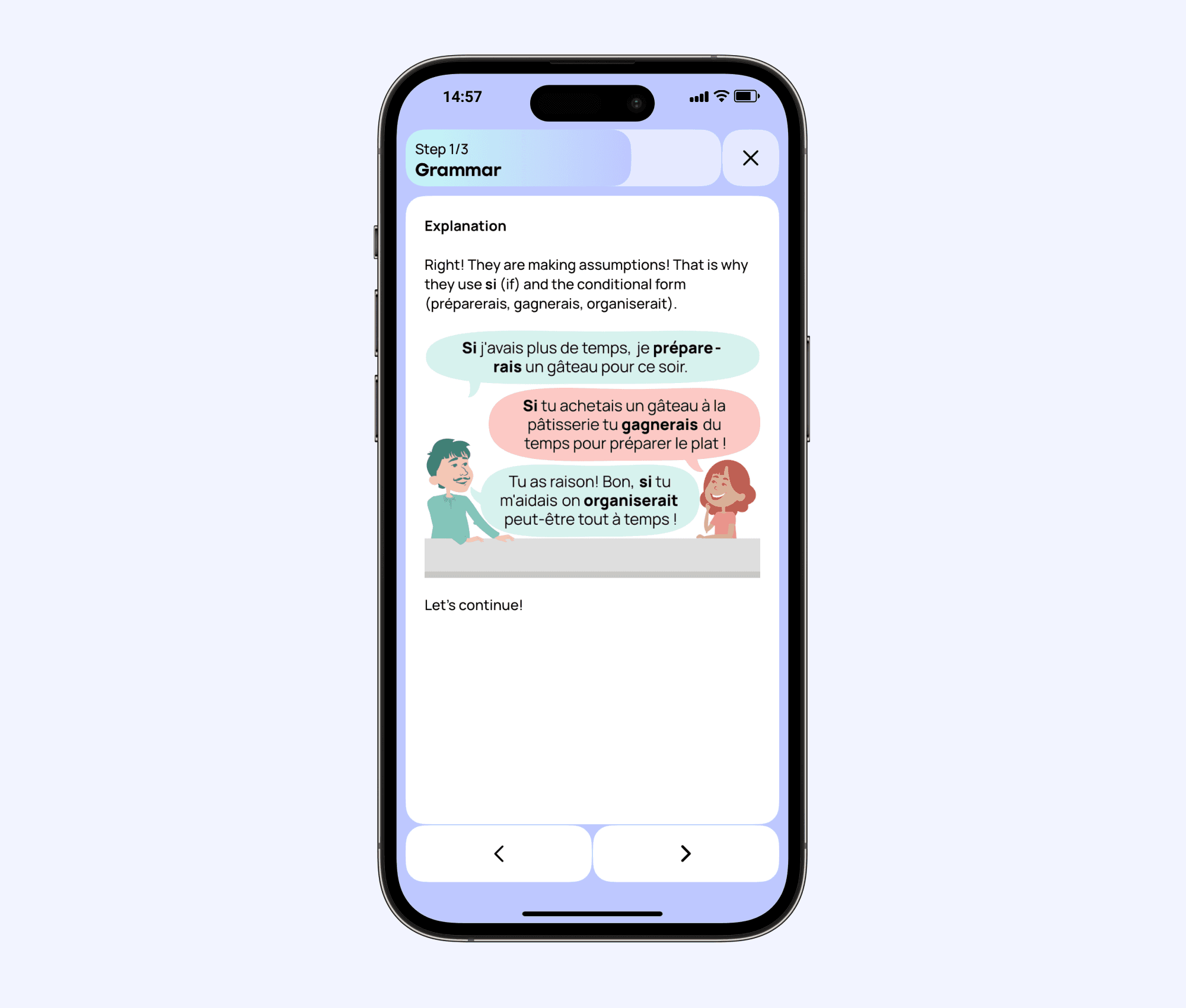
Interactive exercises help you practice real German grammar in action: cases, verb conjugations, prepositions, sentence structure, and more. With instant feedback and clear explanations, you’ll understand not just what is right but why it’s right.

— 06
Progress tracking
Stay motivated by watching your improvement in real time. Promova’s progress tracker measures your accuracy, speed, and confidence across lessons, helping you celebrate every milestone as your German grammar skills grow stronger.
— 07
Personalized dashboard
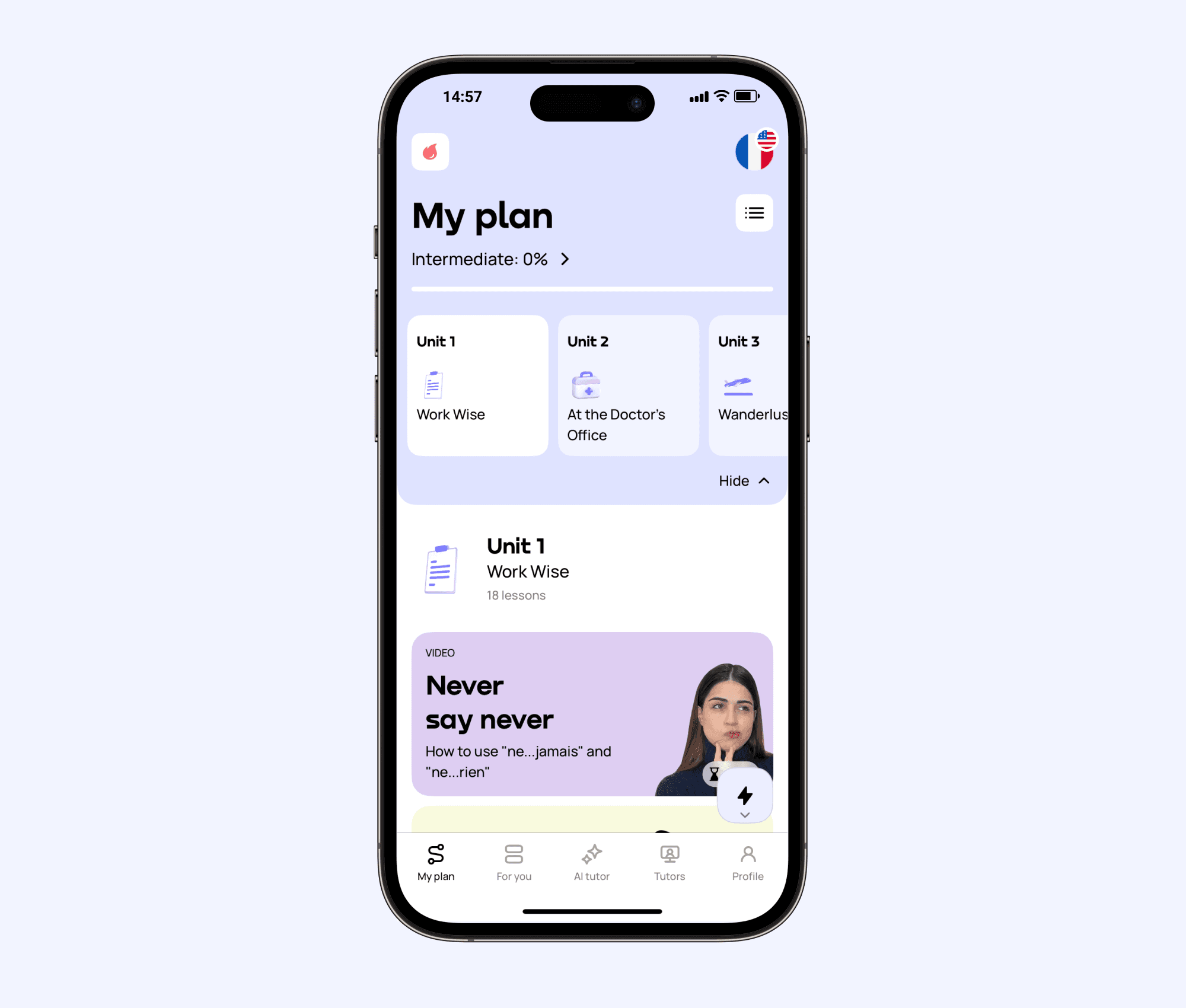
Your Promova dashboard keeps everything organized, from your completed lessons and goals to upcoming practice recommendations. Review your strengths, revisit tricky German grammar rules, and plan your next steps toward mastering German grammar with clarity and confidence.
Free German grammar resources
People often ask
Where do I start learning German grammar?
You can begin with the basics of German grammar for beginners—articles, genders, and the four cases (nominative, accusative, dative, genitive). These are the building blocks of every German sentence.
Promova’s lessons guide you step by step through short explanations and interactive exercises that help you understand how each part works together.
What are the best German grammar lessons online?
You’re in luck! The Promova app has German grammar lessons, vocabulary training, and real-life examples, helping you connect rules with communication. You’ll complete German grammar exercises, test your knowledge with quizzes, and learn how to apply German grammar naturally in real conversations.
Will it take long before I can use German grammar fluently?
We can’t say exactly, as it really depends on your goals and consistency. Most learners begin to use German grammar comfortably within 3 to 6 months of regular practice. Promova’s adaptive learning and daily challenges make progress steady and rewarding, helping you move from memorizing German grammar rules to using them naturally.
Is it harder to learn German grammar than English grammar?
Learning the German grammar basics may seem more complex at first because of cases, gendered nouns, and flexible word order. However, it follows strict and logical patterns.
Once you understand the system, it becomes predictable and even satisfying. Promova simplifies each concept into clear, structured lessons that make German grammar rules easy to follow.
Do I need to memorize all German grammar rules?
Not necessarily. The best way to learn German grammar is through context and practice, not just memorization. Promova helps you discover patterns through examples, dialogues, and German grammar exercises so that it becomes natural and automatic rather than something you consciously recall.
 English
 Français
 Español


