Ordinary Numbers in French: From 1st To 100th
Contents
Key takeaways
- Ordinary numbers in French are the basic counting numbers you use every day, from one to ten and beyond.
- You rely on these numbers for essential tasks like telling time, shopping, or sharing your age.
- Learning ordinary numbers in French gives you a strong foundation for real-life conversations.
- Knowing ordinal numbers in French helps you talk about things like dates, rankings, and order.
- Regular practice helps you remember these numbers and use them naturally in daily situations.
Numbers show up everywhere in daily life. Whether you're checking the time, counting items, or ordering food, you're constantly using them. In French, these basic counting forms are known as ordinary numbers in French. They’re the core numbers—1, 2, 3, and onward—that you use again and again. Many learners call them cardinal numbers, but here we’ll stick to “ordinary numbers” to keep things simple. Learning them is a key step when you want to learn French online and start having real conversations.
It also helps to understand how ordinary numbers in French differ from ordinal numbers in French. Ordinal numbers describe order—like first, second, or third. For example, “le premier jour” means “the first day.” But before diving into those, it’s important to become comfortable with ordinary numbers, since they’re the building blocks for almost all everyday interactions.
What are ordinary numbers in French?
Ordinary numbers in French are the words you use to count things. They match the same counting system you already know, but they’re expressed with French vocabulary. For example, “un” means “one,” “deux” means “two,” and “trois” means “three.” You use these forms whenever you count objects, share your age, or talk about quantities in general.
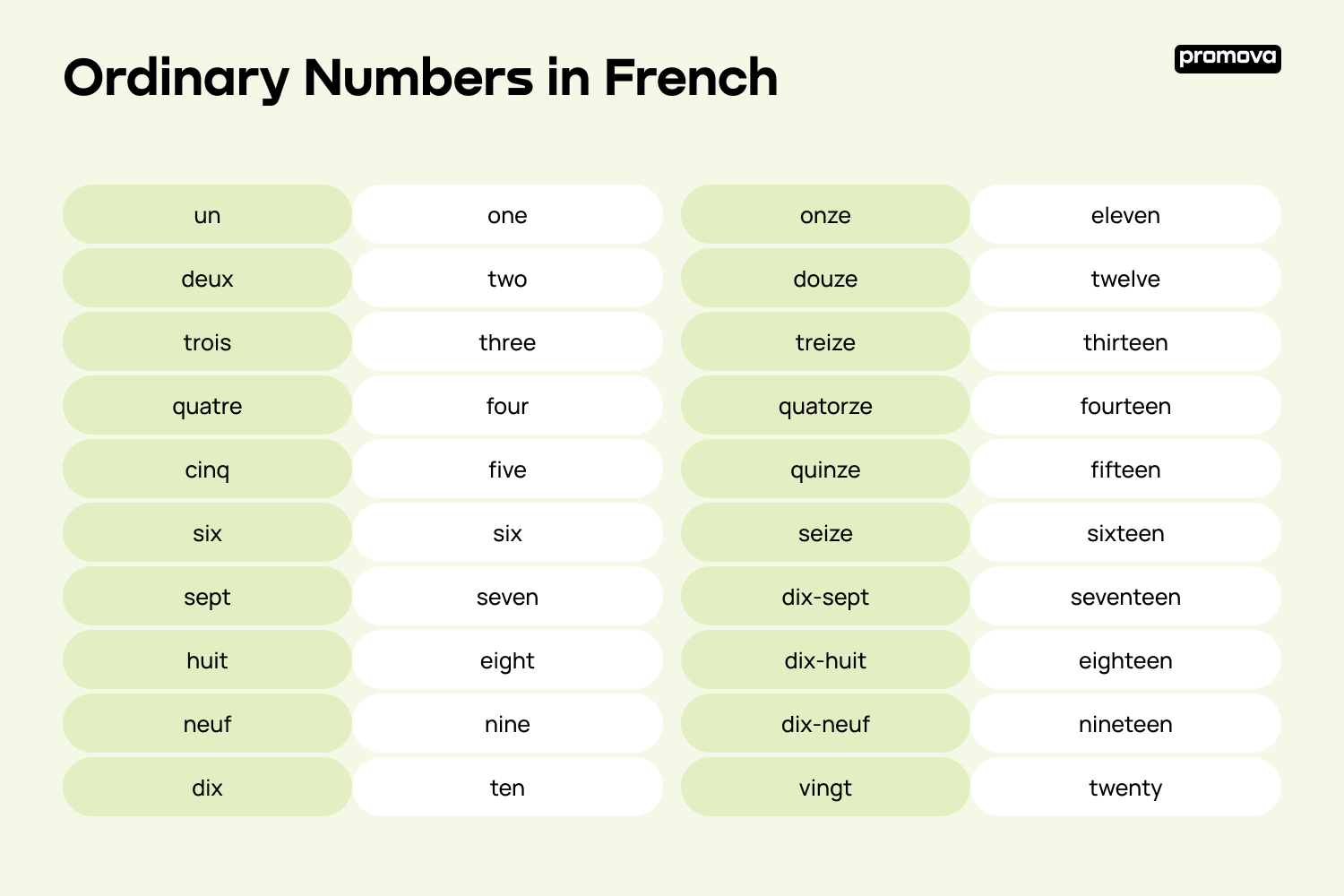
Here are the first ten ordinary numbers in French:
- un (one)
- deux (two)
- trois (three)
- quatre (four)
- cinq (five)
- six (six)
- sept (seven)
- huit (eight)
- neuf (nine)
- dix (ten)
These numbers form the base of the entire French number system. Once you know them well, building larger numbers becomes much easier.
How to use ordinary numbers in French in real life
Ordinary numbers in French appear in common situations every day. You might use them to:
- Say your age: “J’ai vingt ans.” (I am twenty years old.)
- Count items: “J’ai trois pommes.” (I have three apples.)
- Tell the time: “Il est trois heures.” (It is three o’clock.)
- Talk about dates: “Nous sommes le cinq juillet.” (It is July fifth.)
You’ll also see these numbers in phone numbers, addresses, prices, and schedules. Feeling confident with them makes everyday interactions smoother, especially when you’re traveling, shopping, or chatting with French speakers.
Common patterns in ordinary numbers in French
As you learn more numbers, you’ll notice some helpful patterns. The numbers from eleven to nineteen are slightly irregular, but starting at twenty, things become more predictable.
Some examples:
- onze (eleven)
- douze (twelve)
- treize (thirteen)
- quatorze (fourteen)
- quinze (fifteen)
- seize (sixteen)
- dix-sept (seventeen)
- dix-huit (eighteen)
- dix-neuf (nineteen)
- vingt (twenty)
From twenty through sixty, French forms numbers by combining the tens with the units:
- vingt et un (twenty-one)
- vingt-deux (twenty-two)
- vingt-trois (twenty-three)
This pattern continues consistently up to sixty. After that, there are a few extra rules, but the overall structure remains familiar.
Real-life examples of ordinary numbers in French
Here are a few everyday examples showing how ordinary numbers in French appear in real conversation:
- “J’ai vingt-cinq ans.” (I am twenty-five years old.)
- “Il y a trente personnes à la fête.” (There are thirty people at the party.)
- “Le train part à dix-huit heures.” (The train leaves at six p.m.)
- “J’ai acheté quatre livres.” (I bought four books.)
The more you hear and use these forms, the more naturally they start to feel.
Tips for learning ordinary numbers in French
You can learn ordinary numbers in French more easily with the right approach. Try these ideas:
- Count out loud each day to build confidence.
- Use flashcards to remember tricky numbers.
- Play games that include numbers, such as bingo or memory.
- Use numbers in real life—count your steps, name prices, or talk about your age.
Making progress takes time, and it’s completely fine to make mistakes. What matters most is consistent practice and a positive mindset.
Ordinal numbers in French
While ordinary numbers in French help you count, ordinal numbers help you describe order. They show the position of something, like first, second, or third. For example, “premier” means “first,” “deuxième” means “second,” and “troisième” means “third.” You’ll use these forms for dates, floors in buildings, rankings, schedules, and more—such as “le premier jour” (the first day) or “le deuxième étage” (the second floor).
French ordinal numbers are usually formed by adding “-ième” to the base number. Some examples include:
- premier (first)
- deuxième (second)
- troisième (third)
- quatrième (fourth)
- cinquième (fifth)
There are a few irregular forms, but most ordinal numbers follow the same pattern.
Ordinal numbers 1 to 100
Ordinal numbers from 1 to 100 help you understand order in dates, rankings, and events. For example, “le vingtième anniversaire” means “the twentieth anniversary.” Learning these forms helps you talk more clearly about schedules, celebrations, and historical references.
What are the ordinal numbers 1 to 100 in French?
Ordinal numbers from 1 to 100 in French come from adding “-ième” to the base number. A few examples: “vingtième” (twentieth), “trentième” (thirtieth), “cinquantième” (fiftieth). You use these forms to talk about positions, dates, and sequences.
Learn ordinary numbers in French with support on Promova
Learning ordinary numbers in French becomes easier when you study in a supportive space. On Promova, you get guided lessons, bite-sized explanations, and AI-powered speaking practice that help you apply what you learn right away. You can practice at your own speed and get helpful feedback without pressure or judgment.
Whether you're learning for travel, work, or personal interest, Promova helps you use ordinary numbers in French in real-life situations. You’ll also join a friendly community of learners who share your goals and cheer you on along the way.
Final thoughts on ordinary numbers in French
Ordinary numbers in French play an important role in everyday communication. You use them when you count, tell the time, talk about age, or explain simple daily details. Once you learn these numbers, you’ll feel more confident and comfortable speaking French.
Progress builds step by step, not all at once. Keep practicing, stay curious, and let your skills grow naturally.
FAQ
What are ordinary numbers in French?
Ordinary numbers in French are the basic counting forms, like one, two, and three. You use them for activities such as counting objects, telling your age, and describing quantities. They form the foundation for the entire number system in French.
How do I use ordinary numbers in French in real life?
You use ordinary numbers in French to count items, tell the time, talk about your age, or mention dates. For example, “J’ai trois pommes” means “I have three apples,” and “Il est trois heures” means “It is three o’clock.” These forms also appear in phone numbers and prices.
What are ordinal numbers in French?
Ordinal numbers in French describe order—like first, second, or third. Common forms include premier, deuxième, and troisième. You use them to talk about dates, rankings, floors of buildings, and positions in lists.
How can I practice ordinary numbers in French?
You can practice by counting out loud, using flashcards, playing number-based games, or using numbers in daily tasks. On Promova, you’ll find guided lessons and AI-powered speaking practice that help you learn these forms in a fun and effective way.
Make your next step to fluency with Promova
 English


Comments