Subject-Verb Agreement in English
Contents

Subject-verb agreement is one of the fundamental grammar rules in English, yet it’s an area where many learners stumble. So what is subject-verb agreement and how do you master it? In this guide, you’ll explore key rules, exceptions, and typical mistakes — plus helpful examples to keep your grammar sharp.
What is Subject-Verb agreement?
Subject-verb agreement means that the subject and verb in a sentence must match in number. In simpler terms, if the subject is singular, the verb must also be singular. If your subject is plural, the verb must also be plural.
Example:
- She walks to school. ("She" and "walks" are both singular here.)
- They walk to school. ("They" and "walk" are both plural here.)
Clear subject-verb agreement makes your writing easier to read and your meaning clearer.
Why does Subject-Verb agreement matter?
Subject-verb agreement in English is essential for constructing clear and grammatically correct sentences.
When the subject and verb do not agree, your writing can become confusing or misleading. Consistent agreement helps readers easily understand the message you’re trying to convey and ensures your communication sounds natural and professional.
Examples of Subject-Verb agreement
Handy examples of subject-verb agreement:
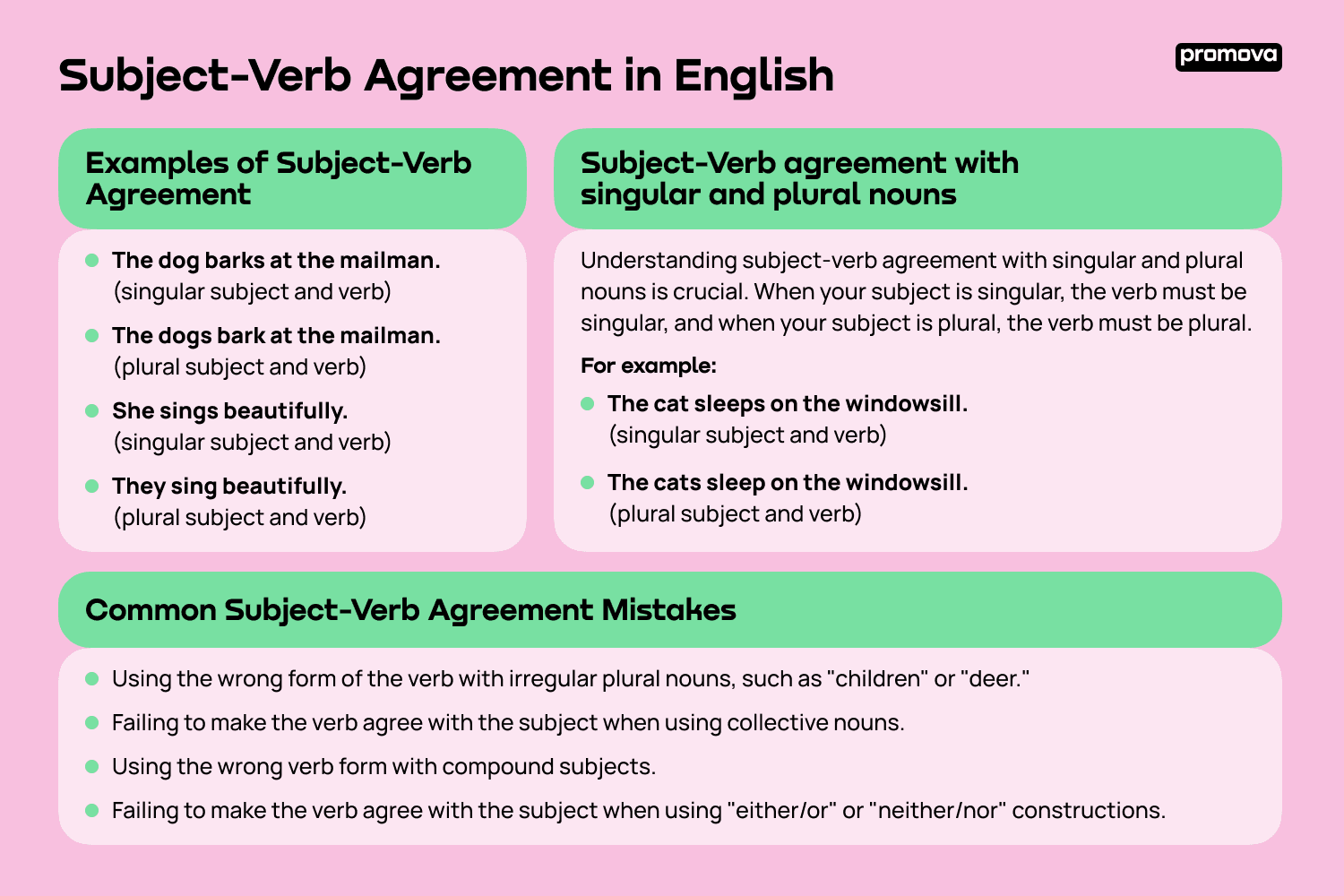
- The dog barks at the mailman. (singular subject and verb)
- The dogs bark at the mailman. (plural subject and verb)
- She sings beautifully. (singular subject and verb)
- They sing beautifully. (plural subject and verb)
As you can see, the subject and verb agree in number in each of these examples. The forms of the same verb change depending on whether the subject is singular or plural.
Tip: Identifying the main verbs in a sentence is key to ensuring subject-verb agreement.
1
Subject-Verb agreement rules and exceptions with singular and plural nouns
Understanding how singular and plural nouns affect verb agreement is important for writing grammatically correct sentences. The form of the verb must always align with the number of the subject:
1. A singular subject takes a singular verb.
The dog barks at strangers.
2. A plural subject takes a plural verb.
The dogs bark at strangers.
3. Use the correct present tense form based on the subject.
He writes every day.
They write every day.
4. Collective nouns like team, family, or group can be singular or plural, depending on context:
The team is playing well. (one unit)
The teams are arguing amongst themselves. (separate individuals)
5. Compound subjects joined by “and” usually take a plural verb:
The cat and the dog are playing together.
6. Sentences starting with “there” or “here”. The verb agrees with the noun that follows:
There are two cats in the garden.
Here is the book.
7. Compound nouns with "or/nor" follow the closest noun:
Neither the cat nor the dogs are hungry.
Either the dogs or the cat is hungry.
8. Descriptive phrases between the subject and verb do not affect agreement. Focus on the main noun.
The basket of apples is on the table.
The quality of the photos depends on the lighting.
Always identify the core subject, and don’t be misled by additional words or phrases. Clear recognition of singular and plural forms leads to correct verb usage.
Common Subject-Verb agreement mistakes
Now that you understand the rules and exceptions of subject-verb agreement, let's take a look at some of the most common mistakes:
- Using the wrong form of the verb with irregular plural nouns, such as "children" or "deer."
❌ The deer eats leaves.
✅ The deer eat leaves. ("Deer" as plural in both cases.)
- Failing to make the verb agree with the subject when using collective nouns.
❌ The team are winning the game.
✅ The team is winning the game. ("The team" as one unit.)
✅ The team are arguing among themselves. ("The team" as individuals.)
- Using the wrong verb form with compound subjects.
❌ Pizza and soda is my favorite meal.
✅ Pizza and soda are my favorite meal.
- Failing to make the verb agree with the subject when using "either/or" or "neither/nor" constructions.
❌ Either the cats or the dog are outside.
✅ Either the cats or the dog is outside.❌ Neither the manager nor the employees is responsible.
✅ Neither the manager nor the employees are responsible.
How Promova can help you master grammar
- Subject-verb agreement is just one part of mastering English. On the Promova platform, learners can access:
- Bite-sized grammar lessons and interactive quizzes tailored to your level
- Speaking practice with an AI Tutor for real-life conversations
- 1:1 and group classes with our expert English tutors for personalized help
- Promova Corporate training solutions for teams and companies to improve workplace communication skills, with a focus on English grammar for business needs
With the right tools, mastering grammar can be simple and even fun!
Summary
By matching the subject with the verb in number, you can avoid confusion and ambiguity in your English. Remember to consider the rules and exceptions when using subject-verb agreement, as well as common mistakes to avoid. With practice, you will master subject-verb agreement in no time!
FAQ
What is "Subject-Verb Agreement" in English?
Why is "Subject-Verb Agreement" important in writing?
What are some common mistakes in "Subject-Verb Agreement"?
How can one improve their understanding of "Subject-Verb Agreement"?
Make your next step to fluency with Promova

 English
 Français
 Português
 Español


Comments