Spanish Accents: A Deep Dive into Diacritics

Contents
Diacritics play a crucial role in the Spanish language. They are more than decorations; they influence pronunciation, meaning, and sometimes even verb tense. Understanding the ins and outs of Spanish accents may seem daunting. However, gaining command of diacritics will add nuance to your language abilities. Keep reading this guide to learn about the variety of Spanish accents, their rules, and implications.
Historical Evolution of Accents in Spanish
The history of accent marks in Spanish is intertwined with the evolution of the language itself. As Latin transformed into the various Romance languages, including Spanish, the need for clearer pronunciation and differentiation of words became evident. Diacritics emerged as a solution to these linguistic challenges.
In the early days of written Spanish, scribes often used accents to distinguish between homonyms. For instance, más (more) was differentiated from mas (but). Such distinctions were crucial to avoid misunderstandings in both spoken and written communication.
For instance, the acute accent, perhaps the most common diacritic in Spanish, originates in ensuring clarity of stress placement. In a language where word stress can change the meaning or tense of a word, indicating the correct stress becomes vital. For example, hablo (I speak) and habló (he/she spoke) are differentiated only by the accent.
Over time, as the Spanish language spread across continents, regional variations began to emerge. These variations further underscore the importance of diacritics in maintaining clarity and uniformity. Today, while some modern dialects and colloquial forms of Spanish may overlook certain diacritics, their role in formal, written Spanish remains as crucial as ever.
Spanish Letters with Accents: Exploring The Types of Diacritics
At the heart of Spanish diacritics are three primary accent types: la virgulilla (ñ), la tilde (á, é, í, ó, ú), la diéresis (ü). Each of these accents serves a distinct purpose, guiding both native speakers and learners in articulating words correctly. In total, there are seven Spanish accented letters: á, é, í, ó, ú, ñ, and ü. So, let’s explore diacritics in more detail.
Diéresis
La diéresis, represented by two dots (¨) placed over the letter ‘u,’ is a unique diacritic in the Spanish language. Its primary function is to signal that the ‘u’ should be pronounced in places where it would typically be silent. For instance, in the word pingüino, without the diaeresis, the ‘u’ would be silent, and the word would sound like ‘gero.’ However, with the diaeresis, both the ‘g’ and the ‘u’ are pronounced, resulting in the correct pingüino (penguin).
While the diaeresis is not as commonly used as some diacritics, its presence is essential for the accurate pronunciation of specific words. It ensures that the surrounding letters do not overshadow the ‘u,’ especially after a ‘g’ and before an ‘e’ or ‘i.’
Virgulilla
La virgulilla, a small squiggly line, is exclusively used atop the letter ‘n’ in Spanish, transforming it into ‘ñ.’ This diacritic introduces a new sound altogether. While ‘n’ is pronounced similarly to the English ‘n,’ the ‘ñ’ has a distinct ‘ny’ sound, as in ‘canyon’.
The distinction is crucial in differentiating words. For example, “maño” (a colloquial term for a person from Aragón, Spain) is different from “mano,” which means “hand.” La virgulilla, in this case, not only changes pronunciation but also ensures clarity in meaning. It’s worth noting that ‘ñ’ is considered a separate letter in the Spanish alphabet, further highlighting its significance.
Tilde
La tilde is the most prevalent diacritic in Spanish. It appears as a small diagonal line, slanting from the bottom left to the top right, and can be found over any vowel: á, é, í, ó, and ú. Its primary role is to indicate stress on a particular syllable. In Spanish, word stress can alter meaning, making these accents indispensable.
For instance, si translates to if, but sí with an accent means yes. These symbols not only guide pronunciation but also help in distinguishing between homonyms.
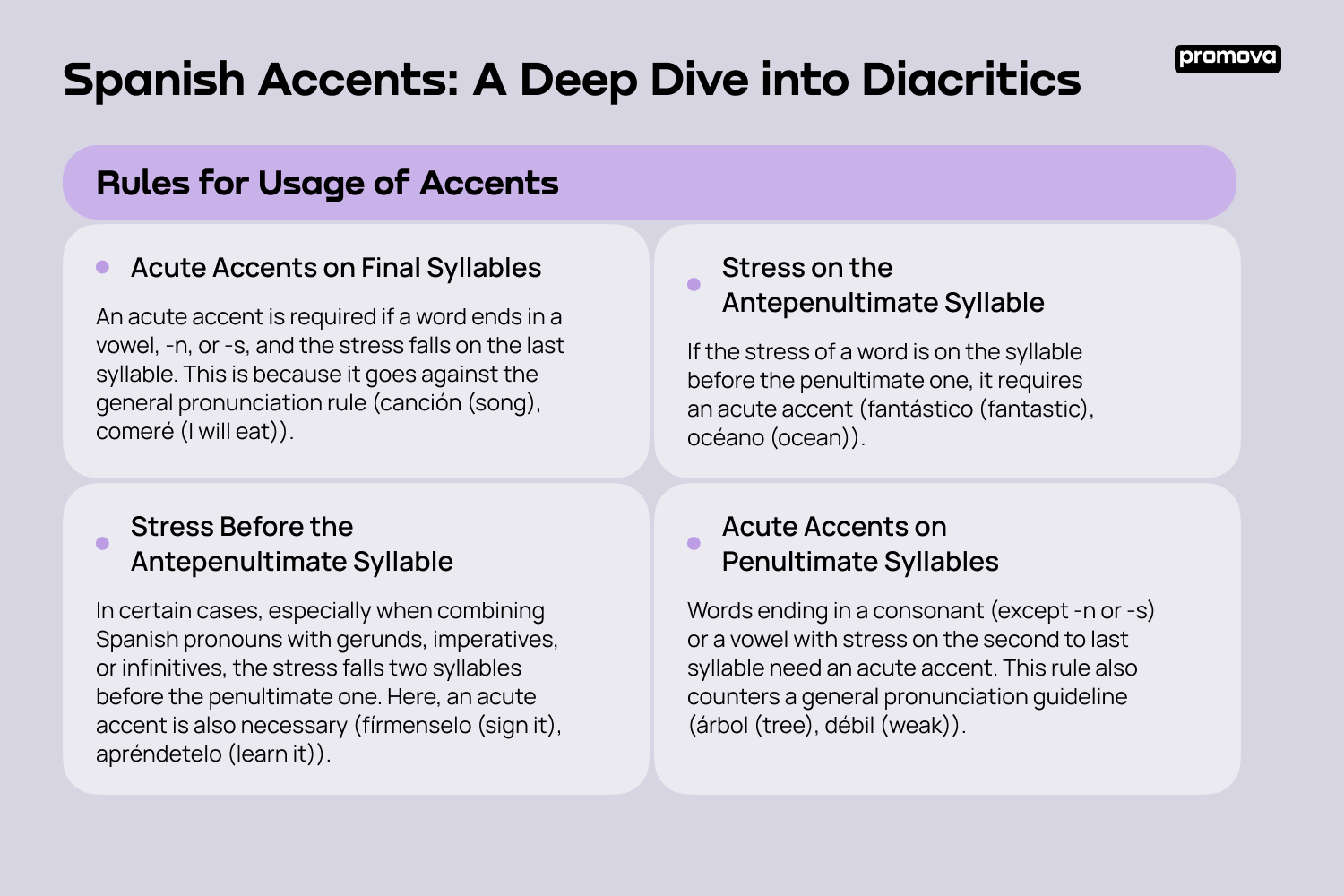
Rules for Usage of Accents
Spanish symbols are governed by specific rules that determine their placement in words. Understanding them is essential for anyone aiming to master Spanish. So, here are the rules:
- Acute Accents on Final Syllables. An acute accent is required if a word ends in a vowel, -n, or -s, and the stress falls on the last syllable. This is because it goes against the general pronunciation rule. For example, Canción (song), comeré (I will eat).
- Acute Accents on Penultimate Syllables. Words ending in a consonant (except -n or -s) with stress on the second-to-last syllable need an acute accent. This rule also counters a general pronunciation guideline. For example, árbol (tree), débil (weak).
- Stress on the Antepenultimate Syllable. If the stress of a word is on the syllable before the penultimate one, it requires an acute accent. For example, fantástico (fantastic), océano (ocean).
- Stress Before the Antepenultimate Syllable. In some cases, especially when Spanish pronouns are attached to gerunds or affirmative commands, stress shifts to a syllable before the antepenultimate position (fourth from the end). In these cases, an acute accent is required to preserve the correct pronunciation. For example, fírmenselo (sign it), apréndetelo (learn it).
Words ending in -mente keep the stress of the original adjective. A useful rule is to apply standard stress rules to the adjective first, since adding -mente does not change the written accent. For example, rápido becomes rápidamente, and fácil becomes fácilmente.
Furthermore, it’s essential to note that all Spanish interrogative words require an acute accent. This rule applies even if the same word doesn’t have the symbol when used in a declarative context. For example, ¿Quién? (who?), ¿Qué? (what?).
Homonyms and Spanish Accent Marks
Homonyms in any language can be a source of confusion, especially for learners. In Spanish, this potential for misunderstanding is addressed, in part, through the use of accent marks. Here are some notable examples:
- Si (if) vs. sí (yes).
- El (the) vs. él (he).
- Mas (but) vs. más (more).
- Te (you, as an indirect object pronoun) vs. té (tea).
- Mi (my) vs. mí (me).
It’s worth noting that the virgulilla in “ñ” creates a distinction that goes beyond the realm of homonyms. The Spanish alphabet considers the letter “ñ” separate from “n”.
In essence, accent marks in Spanish serve as invaluable tools in navigating the language’s intricacies. They provide clarity, eliminate ambiguities, and accurately convey the intended message.
Writing Spanish Accents on the Keyboard
Knowing the shortcuts for Spanish symbols is invaluable for anyone who frequently types in Spanish on a PC. While the Spanish keyboard layout offers direct access to these characters, those using standard English keyboards often need alternative methods. Thankfully, there are a series of keyboard shortcuts and special character codes for typing Spanish accents.
To type Spanish vowels with acute accents, you must hold down the ‘Ctrl’ key and the apostrophe (’) key simultaneously. After releasing both keys, press the desired vowel.
If you wonder how to write “n” in Spanish, here’s an explanation: Hold down ‘Ctrl’ and the tilde (~) key together, release, and press “n.” The result is the Spanish character “ñ.”
However, another efficient method involves using the Alt key in combination with specific numeric codes. It’s essential to use the numeric keypad, typically located on the right side of standard keyboards, for this method. Here are the codes for the most common Spanish characters:
- á: Alt + 0225.
- é: Alt + 0233.
- í: Alt + 0237.
- ó: Alt + 0243.
- ú: Alt + 0250.
- ñ: Alt + 0241.
- ü: Alt + 0252.
- ¡: Alt + 0161.
- ¿: Alt + 0191.
By familiarizing yourself with these shortcuts and codes, typing in Spanish becomes a smoother experience. Whether drafting an email, writing an essay, or chatting with friends, these keyboard techniques ensure you convey your message accurately and authentically.
11
Promova – Your One-Stop Solution for Language Learning
Are you ready to take your language skills to the next level? Look no further than Promova, the ultimate language learning platform. Whether you’re a beginner or an advanced learner, Promova has resources to enhance your language proficiency.
With our guided courses on the Promova app and website, you can access well-structured lessons covering vocabulary, grammar rules, and interactive quizzes. You can learn quickly and tailor your experience to suit your needs.
And if you’re looking for additional learning resources, check out our regularly updated blog. From language tips and tricks to the discovery of English accent types, the Promova blog supplements your language journey.
Conclusion
Spanish accent marks are pivotal in shaping the language’s clarity and rhythm. These diacritics guide pronunciation, differentiate meanings, and ensure effective communication. As we’ve delved into their history, rules, and Spanish accent keyboard typing techniques, the importance of these symbols becomes evident. So, while it might take some effort to get used to these shortcuts, it’s worth it. With practice, typing Spanish accents becomes second nature, enhancing your writing and communication.
FAQ
How do Spanish accent marks compare to those in other Romance languages?
Each language has developed its system of diacritics to address its unique linguistic needs. While Spanish uses primarily the acute accent, other Romance languages like French and Portuguese employ a wider variety of diacritics, including grave and circumflex accents.
How have Spanish accent marks evolved with the advent of digital communication?
With the rise of digital communication, there’s been a trend, especially among younger generations, to omit accent marks in informal settings like texting or social media. However, the correct use remains standard in formal writing and publications.
Are there tools that can automatically correct Spanish accent marks?
Many word-processing software programs have built-in spell checkers that recognize Spanish and suggest or automatically correct symbols. Additionally, tools like Grammarly offer Spanish language settings that can help with accent placement.
What are some useful resources for Spanish learners?
Several resources are available online for learning Spanish, including dictionaries like WordReference. These platforms offer detailed explanations of word meanings, including the correct usage of accent marks. Also, the Promova Spanish language learning app provides comprehensive lessons covering different aspects of the Spanish language.



 English
 Français
 Português
 Español


Comments