How to learn Korean on your own

Contents
Key Takeaways
- Learning Korean on your own is possible, but it requires patience, consistency, and a structured learning plan.
- It takes about 2200 hours to become fluent in Korean. However, you can achieve basic conversational fluency much earlier than that.
- When starting to learn Korean, avoid Romanization. Instead, start by memorizing the Korean alphabet (Hangul). This will help with reading comprehension and pronunciation.
- Using the correct resources for grammar, vocabulary, listening, and speaking can go a long way. Use immersion at home to make faster progress.
Any fan of K-dramas has thought, at least once, that they should learn Korean. The same goes for makeup lovers, business people, and travel enthusiasts. Korean is such a beautiful language with a rich culture and history. But can you learn it on your own? Or is Korean simply too complex to figure out at home?
Is it Actually Possible to Learn the Korean Language on Your Own?
The good news is that it’s absolutely possible to learn any language on your own, and that includes Korean! The Foreign Service Institute, or FSI, places Korean in the fifth category. This means that to achieve fluency, you need to spend approximately 88 weeks or 2200 hours learning Korean.
However, achieving basic conversational ability will take much less time. You may not sound like a native speaker in a matter of weeks, but with a smart strategy, you can effectively learn Korean at home and see real results.
In short, there is no need to hire an expensive Korean tutor just yet. You can figure this language out on your own — at least as long as you follow the right steps.
How to Learn Korean on Your Own: Step-by-step Guide
Before starting your Korean learning journey, decide on how you want to go about approaching the language. A structured learning plan will go a long way and make everything easier for you down the line. Here are some ideas to get you started:
Step 1: Start With Hangul, Not Vocabulary
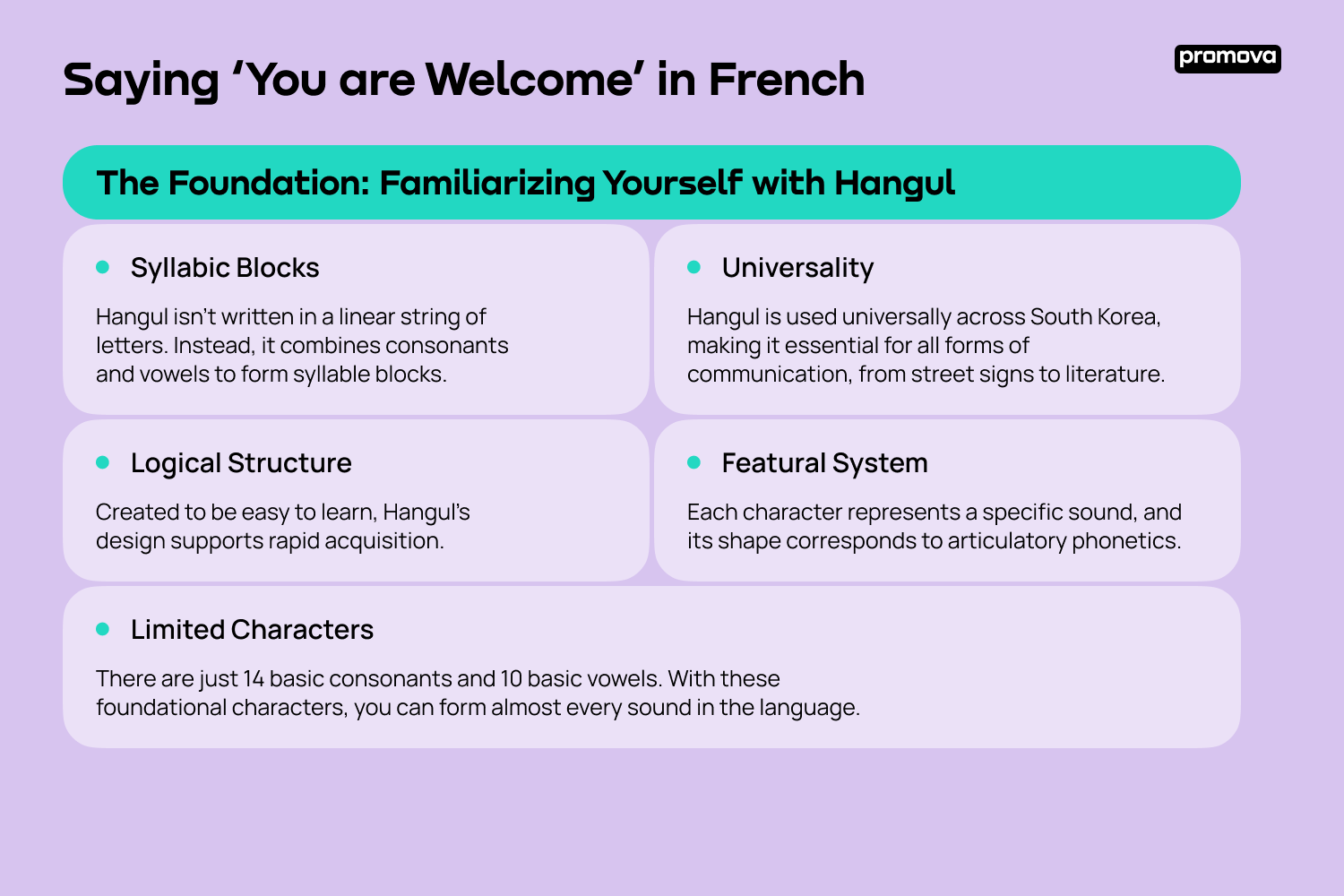
The single most important step in learning Korean is mastering Hangul, also known as the Korean alphabet. Many beginners try to use Romanization (writing Korean words with English letters), but this can actually distort your pronunciation and cause issues with your reading and writing later on.
If you’re wondering how to learn Hangul, start by focusing on its first 24 letters. There are 40 letters overall, but the other 16 are compound letters. You can learn those after memorizing the core 24.
Fun fact: Hangul was deliberately designed in the 15th century by King Sejong the Great, specifically to be easy to learn. It’s one of the most logical writing systems in the world, so don’t be scared to get started!
Step 2: Build a Simple Daily Routine (Not a Study Marathon)
One of the biggest pitfalls for language learners is burnout. The temptation to master Korean as quickly as possible may be big, but the downsides are even bigger. Studying for 3 hours every single day and learning 500 new words a week simply isn’t sustainable.
Instead of speed and perfection, focus on progress and consistency. A manageable daily routine could look like this:
- 10 minutes: Vocabulary review using spaced repetition flashcards.
- 10 minutes: Reading grammar explanations and completing exercises.
- 10 minutes: Listening and speaking practice.
Consistency may be hard, but it’s one of the most important Korean self-study tips you’ll get. Just remember: slow and steady wins the race, so there’s no need to overdo it.
Step 3: Use the Right Resources for Each Skill
Don’t just buy an expensive textbook and call it a day. In this day and age, you have so many helpful learning resources right at your fingertips. All you need to know is where to look. These are some of the most popular recommendations for self-studiers:
- Korean grammar: Whether it’s learning about Korean verbs or trying to understand Korean sentence structure.
- Korean vocabulary: Use spaced repetition apps. These will help you memorize vocabulary more easily and achieve long-term word retention.
- Listening comprehension: Watch your favorite K-dramas or vlogs on your favorite Korean YouTube channel. You can also listen to Korean podcasts, such as IYAGI or ChoiSuSu's Korean Podcast, which are both suitable for beginner learners.
- Speaking practice: This is often the hardest part when you’re learning on your own. Using tools like Promova can be a game-changer. It allows you to practice real conversations without the pressure of being judged and improve your Korean pronunciation.
1
Step 4: Make Korean Part of Your Daily Life
You don’t need to live in Korea to make the language part of your daily life. There are several things you can do to immerse yourself in Korean culture and absorb the language faster.
- Change your phone settings: You can change the language of your phone to Korean. This way, you’ll learn basic vocabulary, such as “message,” “phone,” “app,” etc.
- Learn Korean with K-dramas: In your spare time, watch Korean TV shows with Korean subtitles. This will do wonders for your listening skills.
- Listen to K-pop: Listen to Korean music and look up the lyrics later. This is a great way to learn more about Korean culture while also enhancing your language skills.
- Use post-it notes: Put a post-it note with the Korean word for “mirror” on your mirror, the word for “closet” on your “closet,” etc. Just by looking at these every single day, you’ll learn more basic Korean vocabulary without much effort.
How to Self-study Korean: 3 Common Mistakes to Avoid
Mistakes are part of the learning journey, and you shouldn’t be afraid to make them. However, that doesn’t mean that you can’t be smart about your approach. Many learners make these three simple mistakes that, in reality, are easy to avoid. Make sure you skip them in your own self-study.
- Relying only on romanization: As mentioned above, it’s a crutch that will eventually break. Learn the sounds of Hangul as they are instead. It will give you bragging rights among your friends, too. Who wouldn’t be impressed by someone knowing an entirely different alphabet?
- Skipping speaking practice until “ready”: Many learners wait until they “know enough” to start speaking, but the truth is that you’ll never feel 100% ready. The longer you wait, the more nerve-racking it will become. Start speaking from day one to avoid these unnecessary nerves.
- Switching resources too often: It’s tempting to download ten different apps and hop from one to the other. However, this will stall your progress. Pick one resource and stick to it for at least a couple of weeks. You can change it if it’s not working for you, but don’t get stuck trying too many different things at once.
How Long Does It Take to Start Speaking Korean?
While the FSI’s 2200 hours is what you need to achieve fluency, that’s not the end-all, be-all of speaking Korean. You should start practicing speaking from day one. With consistent effort and focus, most learners are able to achieve basic conversational ability in just a few months.
For example, within 3 to 6 months, you should be able to introduce yourself, order food at a restaurant, and ask for directions confidently. Sure, you won’t be debating philosophy just yet, but you will be participating in the language. Just remember: learning a language isn’t a sprint. It’s more of an impressive hike that requires careful consideration and plenty of stamina.
Final Thoughts
Learning Korean on your own doesn’t have to be scary. In fact, it can be a beautiful and exciting journey full of self-discovery and cultural expansion. If you’re a complete beginner, start by mastering Hangul. Then, you can move on to learning other basics, such as numbers in Korean or basic sentence structure. You’ll be able to show off some skills sooner than you think.
The most important thing is to stay consistent and not give up. Speed and perfection don’t matter when it comes to language learning. Only those who can keep at it achieve real results. So stay patient with yourself and keep going. You’ve got this!
FAQ
Can I learn the Korean language by myself?
Yes, you can learn Korean by yourself. While Korean is considered one of the more difficult languages to learn for English speakers, it is far from impossible. For example, the Korean alphabet, Hangul, was specifically designed to be easy to learn. All you need to make real progress is consistency, structure, and passion for the language.
Which is harder, Korean or Japanese?
Japanese and Korean are of similar difficulty, but the reasons why they are challenging differ. While Korean pronunciation is a little more complicated than Japanese pronunciation, Hangul is much easier to learn than the Japanese alphabet, which includes Hiragana, Katakana, and thousands of Kanji characters borrowed from Chinese.
Is Korean grammar difficult?
The truth is that it’s very different from English grammar, which is why many consider it to be hard. Korean uses a Subject-Object-Verb (SOV) structure, which isn’t always natural for non-native speakers. It may take a little rewiring of the brain, but it’s very consistent once you get the hang of it.
What is the hardest part of learning Korean?
One of the most challenging parts of learning Korean is mastering Korean honorifics. In this language, different words and verb endings are used based on the other person’s age and social status. This is not something that happens in English and may, therefore, take some getting used to at first.



 English
 Français
 Português
 Español


Comments