English Greetings and Introductions: Phrases and Examples
Contents
Key Takeaways
- English greetings can be formal (“Good morning”, “How do you do?”) or informal (“Hi, what's up?”).
- Introductions change depending on the situation—you can introduce yourself, someone else, or respond politely.
- Avoid common mistakes like using “Good night” as a greeting or being too informal in professional settings.
- Practicing with real examples and apps like Promova helps you master English greetings and introductions and feel more confident when meeting new people.
Learning how to greet and introduce yourself in English is one of the first things every learner should master. These moments are key to making a good impression—whether you're in a formal meeting, making new friends, or traveling abroad.
In this guide, you’ll find useful phrases, clear examples, and practical tips to help you use English greetings and introductions with confidence. Let’s get started!
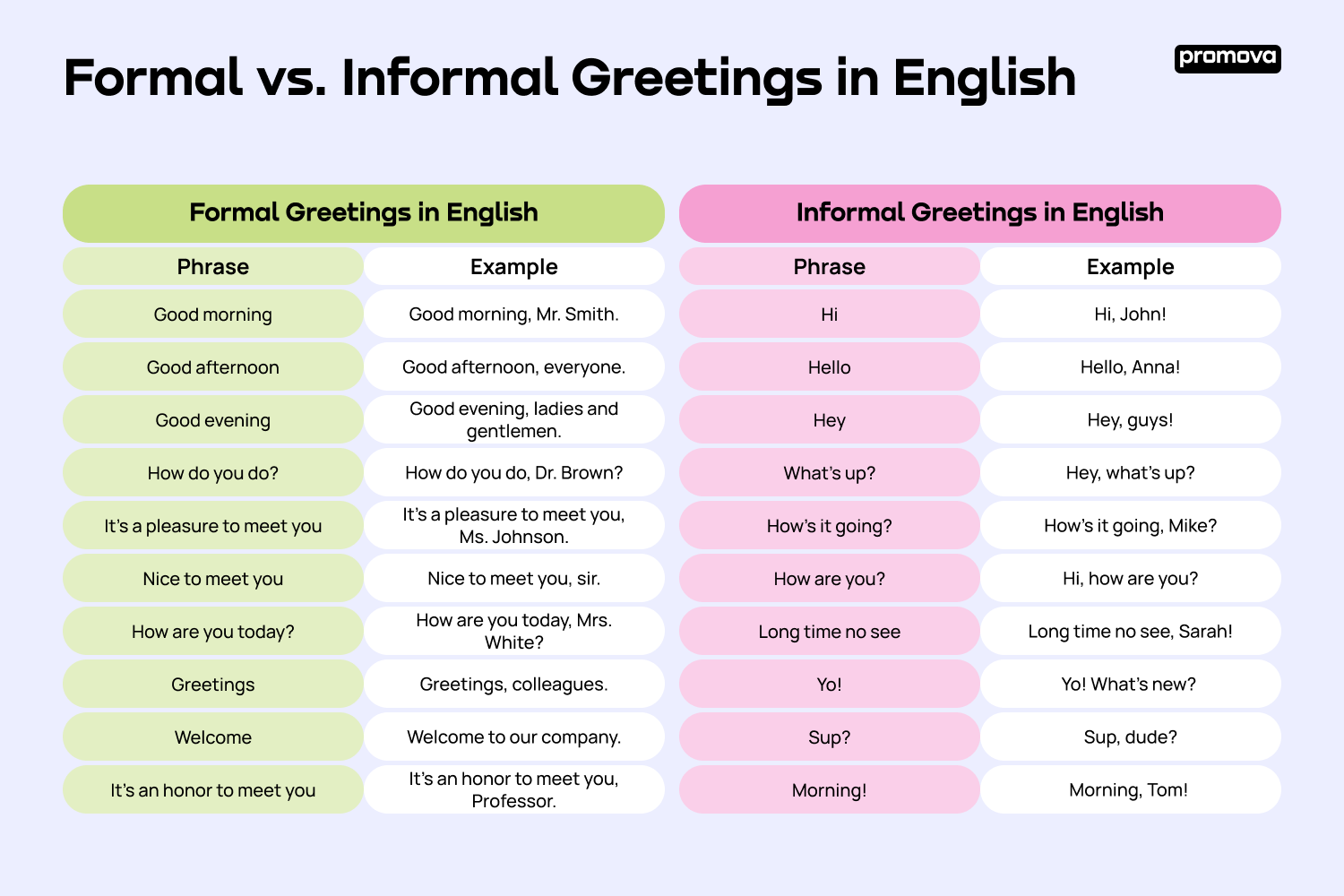
Formal vs. Informal Greetings in English
In English, greetings change depending on the situation and your relationship with the other person.
- Formal greetings are used in professional settings or when you don’t know the person well.
- Informal greetings are relaxed and common among friends, family, or close people.
Knowing when to use formal or informal phrases helps you sound polite, natural, and respectful in every situation.
Formal Greetings in English
These greetings show respect and politeness, perfect for job interviews, business meetings, or official events.
| Phrase | Example sentence |
| Good morning | Good morning, Mr. Smith. |
| Good afternoon | Good afternoon, everyone. |
| Good evening | Good evening, ladies and gentlemen. |
| How do you do? | How do you do, Dr. Brown? |
| It’s a pleasure to meet you | It’s a pleasure to meet you, Ms. Johnson. |
| Nice to meet you | Nice to meet you, sir. |
| How are you today? | How are you today, Mrs. White? |
| Greetings | Greetings, colleagues. |
| Welcome | Welcome to our company. |
| It’s an honor to meet you | It’s an honor to meet you, Professor. |
Informal greetings
Informal greetings convey warmth and trust, making them perfect for friends or relaxed situations:
| Phrase | Example sentence |
| Hi | Hi, John! |
| Hello | Hello, Anna! |
| Hey | Hey, guys! |
| What’s up? | Hey, what’s up? |
| How’s it going? | How’s it going, Mike? |
| How are you? | Hi, how are you? |
| Long time no see | Long time no see, Sarah! |
| Yo! | Yo! What’s new? |
| Sup? | Sup, dude? |
| Morning! | Morning, Tom! |
Informal Greetings in English
After greeting someone, it's time to introduce yourself. This will help you break the ice and establish positive relationships with greater confidence.
Let's look at how to introduce yourself, how to introduce others, and how to respond in different situations.
How to Introduce Yourself in English
These phrases help you talk about who you are, whether you're in a formal meeting or a casual conversation.
| Phrase | Use | Example sentence |
| My name is… | Formal/informal | My name is Laura. |
| I am… | Informal | I am Alex. |
| Let me introduce myself | Formal | Let me introduce myself, I am Mr. Green. |
| I’m from… | Informal | I’m from Mexico. |
| I work as a… | Formal/informal | I work as a teacher. |
| I’m studying… | Informal | I’m studying English. |
| I’m interested in… | Formal/informal | I’m interested in marketing. |
| People call me… | Informal | People call me Sam. |
| It’s nice to meet you, I’m… | Formal | It’s nice to meet you, I’m Sarah. |
| Just call me… | Informal | Just call me Mike. |
7
How to Introduce Someone in English
Introducing others is a polite way to help people connect and feel welcome in a conversation.
| Phrase | Use | Example sentence |
| This is… | Informal | This is my friend, Anna. |
| I’d like you to meet… | Formal | I’d like you to meet Mr. Brown. |
| May I introduce… | Formal | May I introduce my colleague, John? |
| Meet… | Informal | Meet my cousin, Tom. |
| Let me introduce… | Formal | Let me introduce our manager, Susan. |
| Here’s… | Informal | Here’s my brother, Paul. |
| I want you to meet… | Informal | I want you to meet my friend, Lisa. |
| Allow me to introduce… | Formal | Allow me to introduce my assistant, Peter. |
| Please meet… | Formal | Please meet our new teacher. |
| Do you know…? | Informal | Do you know my friend Alex? |
Common Responses When Meeting Someone
These responses help you sound polite and friendly when meeting someone new, no matter the situation.
| Phrase | Use | Example sentence |
| Nice to meet you | Formal/informal | Nice to meet you too. |
| Pleased to meet you | Formal | Pleased to meet you, Mr. White. |
| How do you do? | Formal | How do you do? |
| Great to meet you | Informal | Great to meet you, Anna. |
| Good to see you | Informal | Good to see you again. |
| The pleasure is mine | Formal | The pleasure is mine. |
| Likewise | Formal/informal | Likewise, Mr. Lee. |
| Happy to meet you | Informal | Happy to meet you, Tom. |
| It’s an honor | Formal | It’s an honor to meet you, Professor. |
| Glad to meet you | Informal | Glad to meet you, Maria. |
Greetings and Introductions in Context: Sample Dialogues
Seeing these phrases work together in a real exchange makes them much easier to remember than a list alone. Here's the same basic conversation — meeting someone, asking their name, asking how they are — played out at three levels of formality.
Formal Dialogue
A: Good morning! You must be Olivier.
B: Yes, good morning! I'm sorry, and your name is…?
A: My name's Kasia. Very nice to meet you. Welcome to the office!
B: Thank you.
A: How are you today?
B: Very well, thank you, and yourself?
A: I'm good, thanks for asking.
Neutral Dialogue
A: Hello!
B: Hello! Are you Olivier?
A: Yes, that's right. What's your name?
B: Kasia. Nice to meet you.
A: And you.
B: How are you?
A: Fine, thanks, and you?
B: I'm good, thanks.
Informal Dialogue
A: Hi!
B: Hey! Olivier?
A: Yeah. Your name?
B: Kasia. Good to meet you.
A: You too.
B: How you doing?
A: Yeah, not bad. You?
B: Pretty good!
Notice how the formal version is longer and more explicit (and your name is…?, and yourself?), while the informal one drops words entirely (Your name?, You?). This pattern—formal language being longer and more complete, informal language being shorter—holds true across most greeting exchanges.
Introducing Two People to Each Other
When you're introducing two people who don't know each other, the level of formality changes the phrase, but there's also a quick, informal trick worth knowing: simply say both names, then repeat them in reverse order.
- Formal: "May I introduce my colleague, Olivier?"
- Neutral: "Have you met Olivier?"
- Informal: "John, Emma. Emma, John." — just the two names, said once in each direction, is often all you need among friends.
Common Mistakes to Avoid with Greetings and Introductions in English
When learning how to greet and introduce people in English, it’s normal to make a few mistakes at first. But if you know what to avoid, you’ll feel more confident from the start!
1. Using informal greetings in formal situations
- Mistake: Saying “Hey!” or “What’s up?” during a job interview or professional meeting.
- Solution: In formal settings, use greetings like “Good morning,” “Nice to meet you,” or “Hello, Mr. Smith.”
2. Translating expressions directly from Spanish
- Mistake: Using “Good night” to say hello when you arrive.
- Solution: Remember, “Good night” is only used to say goodbye at the end of the day. If you want to greet someone at night, say “Good evening.”
3. Forgetting to use formal titles
- Mistake: Calling someone you don’t know just by their first name in a professional setting.
- Solution: Use formal titles like Mr. (for men), Ms. (for women), or Dr. (for doctors), especially if you’re not close to the person.
4. Not replying properly to greetings
- Mistake: Someone says “Hi! How are you?” and you only reply with “Hi,” without continuing.
- Solution: Always return the greeting politely, for example: “Hi! I’m good, thank you. And you?” It shows respect and friendliness.
5. Using negative body language
- Mistake: Avoiding eye contact, not smiling, or standing with a closed posture.
- Solution: Smile, make brief eye contact, and keep your posture open. It helps you look more confident and friendly.
With practice, these small mistakes are easy to fix. Your greeting is the first impression—whether in person or online, make it a good one!
Tips to Practice Greetings and Introductions in English
Want to sound more natural when saying hello or introducing yourself? Here are some easy and effective ways to improve your confidence:
- Practice in front of a mirror: Seeing yourself while you speak helps improve your intonation, body language, and confidence. It’s like a private rehearsal!
- Repeat phrases out loud: Say them clearly and naturally. Practice key phrases like “Hi, my name is…” or “Nice to meet you!” until they feel easy.
- Role-play conversations: Ask a friend, classmate, or family member to practice with you. Pretend you're meeting for the first time and take turns greeting and introducing yourselves.
- Listen to English media: Watch series, movies, or listen to podcasts in English. Pay attention to how native speakers say hello and introduce themselves. Take notes and try using the same expressions.
- Use AI-powered apps like Promova: Promova’s AI tutor lets you practice greetings and introductions in a safe space with no pressure. Make mistakes, repeat as much as you want, and improve at your own pace.
With these simple tips, your greetings and introductions will sound more natural every day. Just a few minutes of daily practice makes a big difference!
Master English Greetings and Introductions with Promova
Practicing on your own is helpful—but learning with a dedicated app can speed up your progress and boost your confidence from day one.
With Promova, you can:
- Learn short, practical lessons with useful phrases for greetings and introductions.
- Practice real-life conversations with AI in a relaxed, supportive environment.
- Boost your team’s skills with corporate language classes that drive real results.
- Follow a personalized study plan that matches your level and learning goals.
With Promova, you’ll have everything you need to say hello, introduce yourself, and speak English naturally and confidently.
Final Thoughts
Greetings and introductions in English are the first step to connecting with others. Whether you’re in a job interview, traveling, or having a casual chat, knowing how to say hello and introduce yourself opens doors and builds trust.
With daily practice, simple phrases, and the help of tools like Promova, you’ll soon feel confident speaking in any situation.
Start today—and say hello to the world with confidence!
FAQ
What is the most common way to greet someone in English?
"Hello" and "Hi" are the most universal greetings — they work in almost any situation, formal or informal. For a truly neutral option that fits both casual and professional settings, "Hello" is the safest choice.
How do you introduce yourself in English professionally?
Use a full sentence rather than just your name: "Let me introduce myself, I'm [name]" or "My name is [name], and I work as a [job title]." Adding a formal question like "And your name is...?" instead of the casual "What's your name?" also signals professionalism.
What's the difference between "Nice to meet you" and "Nice to see you"?
"Nice to meet you" is for the first time you meet someone. "Nice to see you" (or "Good to see you") is for people you already know and are seeing again. Mixing these up is a common mistake even at intermediate levels.
How do you introduce two people to each other in English?
In formal settings, say something like "May I introduce my colleague, [name]?" In casual settings, a quick and common trick is to simply say both names once in each order: "John, Emma. Emma, John." This lets both people know who's who without a long explanation.



 English
 Français
 Español
 Português


Comments